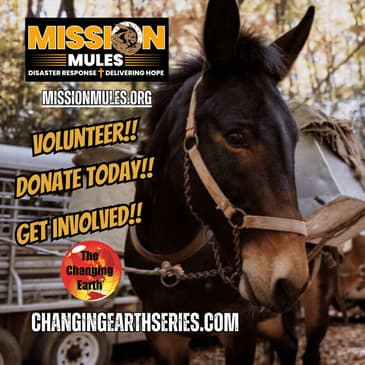
We also discuss the team’s work in Texas after major flooding, where they supported river recovery crews and began exploring new ways to combine mules with drones and communications for future responses. Mike also talks about their international deployment to Jamaica, where they delivered and set up a large-scale water filtration system. This episode is filled with real-world lessons on low-tech resilience, faith in action, community response, and practical preparedness strategies. In this episode we cover:
- How mules were used during Hurricane Helene relief
- The emotional and logistical challenges of the mission
- What the team did in Texas flood recovery
- Expanding capabilities with drones and technology
- Faith, community, and “prepare for the worst, pray for the best”
- Mission Mules: https://missionmules.org
- Prepper Camp 2026
- Season 5 Changing Earth Audio Drama – Part 2 now dropping
Become a supporter of this podcast: https://www.spreaker.com/podcast/prepper-broadcasting-network--3295097/support.
Head to https://bepreparedsolutions.co/partner/pbn, or use code PBN20 when you sign up to get 20% off their incredible preparedness tools, custom plans, and LOCAL INTELLIGENCE.
STOP THE ADS! Become a PBN Supporter for just $5 a month and get exclusive podcasts just for supporters. BECOME A SUPPORTER
The Prepper's Medical Handbook Build Your Medical Cache – Welcome PBN Family
Join the Prepper Broadcasting Network for expert insights on #Survival, #Prepping, #SelfReliance, #OffGridLiving, #Homesteading, #SelfSufficiency, #Permaculture, #OffGrid solutions, and #SHTF preparedness. With diverse hosts and shows, get practical tips to thrive independently – subscribe now!
Newsletter – Welcome PBN Family
Get Your Free Copy of 50 MUST READ BOOKS TO SURVIVE DOOMSDAY
Welcome back to the Changing Earth Podcast with author Sarah F. Hathaway and co host Chen Gibson, blending survival fiction and fact to bring you entertaining education that will help you dream, survive, and thrive. And now here's your host, Sarah F. Hathaway and Chen Gibson. Hello, and welcome back to the Changing Earth Podcast. This is episode number four hundred and ninety three. I think we're in season eighteen or something. I don't know, it's been too many years. Why I got Chin here with me, Ehchan, what's up? Hey? What's up y'all? And I got Mike here with me? Hi, Mike, how are you? I can't wait to get into our interview on SEF. We're doing real good. Thanks for having me. Well, I'm excited to have you here. One of those preparedness freaks that thanks. You're just doing amazing things. So I can't wait to get into it before we dive in a. Couple of announcements, Season five of The Change in Earth Audio Drama Part two just started dropping last week. These are some of my absolute favorite episodes and the video is turning out really cool. So we'll have four episodes in this block, So get out there. If you haven't been listening, you need to get caught up because stuff is getting wild, it's getting crazy, and you won't want to watch these episodes if you haven't got. Caught up yet. Ten you know where we're at. You were like, whoa, all right, right, yeah, we also prepper camp coming up. I'm gonna be getting my book order in. We're getting excited, we're getting ramped up. It is just so close on the doorstep now because it's in August this year, guys, so keep. Wife and I have been doing date date day. We've she's been playing hooky for half a day. We've been running over there seeing all the horse competitions. It's such a such an awesome place. It's every time. Okay, yeah, because there's like three right. Three there, five, there's a bunch of smokes. Yeah. It's just really cool to have such a solid place this day. Not that you know, we didn't always enjoy ourselves before, but excited to have that have them on the docket. So yeah, all right, Mike, So let's get into it. I'm no changing Earth news today. Typically we do a peace on the change in Earth. What's happening over the past month, on our planet and we haven't. You know, there's been some big disasters, but we haven't seen anything that's like really breaking the norm of what the season should be. Right now, solar activity has been good. So we're going to jump right in the interview with Mike and we're going to use up every bit of time that we can because I just have so much that I'm interested in. So Mike, go ahead, introduce yourself, just a brief brief bio where you've been, and we'll pick it up from there. Well, my name is Mike Tober. I'm the president of a mountain mule packer ranch. We what we do is we we're a training company for the military. That's how we got our mules out from California the year and then of course we were responded to Helene and that's where our Mission Mules came in to play. And now we have a nonprofit called Mission Mules. And I've been packing. I'm fifty nine years old. I've been packing for a good forty years now and I come from California. We packed our permit area where the outfit I worked for was our south boundary was in north boundary to U Semity. Kind of give you an idea that. Okay, the range we were in there, and I've been doing it for a long time. That's so cool. So did when you were young, did you always like what did that look up? What did that look like for you in your. When I was young, I used to go into the back country and the immigrant. Wilderness with my dad and my cousin generally, and we would always do week long trips and we would just make big circles long through that. Most of the immigrant wilding debasin down there and along the Huckleberry border, and that's where we spent most of our childhood and that's how I got into it. We get We watched cattle for different ranchers up there, and I wanted to be a packer after because there's two pack outfits where we come from, and to me as a kid, those were just the coolest guys. Ever, you're like doing a little heroism there, Like. I think that you turn yourself into a bigger hero for sure, as far as it. Goes, I don't know about that. So you are a fellow refugee from Alifornia. You know, Yeah, I don't say I don't say that to too many. People, right, yeah, I hear you. Yeah, my family moved there in like the late twenties, early thirties, and that was it was a great state to grow up in. But it just it's so screwed up now that we got out in twenty twelve. It came over by Fort Bragg to work with the military, and we figured we'd stick around here three years and then go back, and uh. After watching it seemed like progress. It progressively got worse masts, so we decided to stay in North Carolina. And we really liked North Caroline, like the people here. The mountains are a little different. There are a lot different, a lot more bush than these mountains first where we come from Cali. Yeah, but yeah, I missed my mountains. I got a little bit of family there and missing them. But I like it over here in the East News I think a lot better now. Yeah, I have to agree with you. It was beautiful country to live in. I lived right between Sacramento and Lake Tahoe up there, so it was like an hour and a half to the to the snow, a couple hours to the beach, and it was a good country. But unfortunately now just to watch what's going on out there, and you know this whole thing with their election, everything is just so corrupt. Yeah, and it really always has been in California. I just think that now it's just blatant it is. They don't care. They don't care. They just do it on taxing their people into a corner and then in sentifizing people to be poor. Basically. Yeah. Yeah, the best kind of prisoner is one who doesn't know they are a prisoner, That's right. So how'd that work? So you had to bring all the mules out from Cali trailing the mountain? Yeah, we did. We in twenty twelve. As when we made the move, we kind of prepped for it for a couple of years. My sister and her husband. Uh, my sister came out to North Carolina to join the military, uh when she was eighteen, and she went to dental school afterwards and got married and had a family. And at the time, her and her husband. Had a body armor company called Paraclet and they made body armor and they sold that company and shortly after they sold it, they built the skydiving wind tunnel there just outside of Fadville. That's what they asked us to come out, uh, because we were we wanted to do training, but the way it was set up, the money for travel was such that they just it wasn't cost effective for him to send them out west to get meal backing training. And after looking into it for a couple of years, we decided that we just needed to bring our show to the schoolhouse there on Fort Bragg especial. So do you a parachute your mules in. Just one time? No, we don't put the mules now there. You know, I've heard stories of during like World War Two, they did that sort of thing. Uh, the survival rate was just it's not something that that that I've ever would whatever they could now, we would fly. We could fly mules around and as long as they could offload the back of a plane or a castle or something like that would work. But as far as dropping them out with a pair of chutes, that's, uh, that's out. Of our. Yeah, that sounds crazy. So I really you told us how much you you know growing up that you were always involved in it. I've never really thought about I thought about horses in the Grand Preparedness scheme, but you know, there's a lot of care that goes into a horse. They're kind of prissy, right. Some can't be yes, ma'am right. So, and then you know on the movies, they're always like, oh, we're going to hook the horses up to the cart and it's just magically going to work, and people don't realize that, Like it doesn't work out. I'm not how good it works, but it will go and usually go pretty fast when it does go. Right, Yeah, yeah, I'm like, that's that's not reality. Like if it was a grid down scenario, you can't just take any horse and hook them up and do that. You can't or. Even put a pack on them. Honestly, right, that's exactly right. I don't know that weight, that any of what's going on. So as just like you need to you need to know what's expected of you, got to know what you're doing. You got to be taught what to do when they need this. And it's the same with the mules or the horses. They just have Once they learn it and they know it and it's not going to hurt them, then they will work for yet. But it takes time. It takes years. You know, we lost some mules during Halleen in that same time area time framing. Week because of the storm. Well, you know, we were up we were up in Ashville. The mules were down in mount Ola, resting Passero down there, and a storm came through and blew a tree down. And the way it knocked the fence down, it didn't come down directly on it, but it laid it over, so there was no wire sticking up. And I think we had nine mules in that corral and four of them got out, got it, made their way to the highway. Uh. Semi hit three of them and killed and we clipped the fourth one and we still have him, but he's he's crippled up. He was the one I used to ride. He was the one I crowed. But so then we got after that happened, we you know, we we weren't sure how long we were gonna be doing this. You know, God put us up there, you know. And how it started is we we the storm come in. We had a training set up with Marsok down to South Carolina, and of course the roads flooded. He got canceled out, but we had a trailer load of mules. We had supplies for a week for the mules for my team. Uh and once the power came back on down where we were over by mores Will. We started seeing what they were saying was inaccessible areas and what was going on, and we decided, all right, we're gonna leave in the morning. We can help with this. We can just replace the weapons and AMMO and guns. With food and water, and that's what we'll do that for a few days, see how we can help out. So we headed up there and we just went and like the first run was eleven days. We had to rest and replace, get different mules, and then we come up. But five months later we were still taking the supplies up there, not by mule but by truck. So it wasn't just a quick in and out like we thought it was gonna be. We you know, how long do we do this? You know? Because I worked for a couple of ranches and I trained the military. Uh, and like those ranch jobs were going to go away here soon if I didn't get back to them. My wife worked for insurance company and she pretty much was going to lose her job. So we were just figuring, you know, what, is God going to tell us we've done what we needed to And then we got those mules that got killed, and then we decided Okay, that's this is that's telling us. You know, it basically cut my workforce down. So now I'm down three mules, four mules actually, so I couldn't. Train the way I needed, so I needed to purchase mules. And we figured this is this is where we get off and go back to life, try to recoup our jobs and all that. And uh, next day we. Got a call from Samaritan's Purse and we they'd done air drops for us in ran Mountain. And like Elk Park, North Carolina. Yeah, and that's how we met them, and they'd heard about what happened and they basically said, you need to keep going. We want to well replace your mules and and then some, but you need to continue what you're doing. That's me and so that's what that's so we never did get out. That was our sign. Change our lives up. And that's amazing. What a what a hand You. Know, Hey, Mike, can I for a second, so I got the privilege of meeting you in person. You came to talk to our third group a monthly meeting and we actually had you had a video and stuff. Can you kind of describe like what your mule set up looks like and like you had like a mule train, and just so the people get a kind of understanding of really what you did. Yeah, So, like if you're looking at that picture, there's there's two saturdays, a pack saddle on the left and they are riding saddle on the right. The pack saddle is designed to hang paniers on the side, which are the side boxes or bags. They can be harder or soft, and that's what all the supplies or whatever you're hauling goes into. And then what you'll do is you'll string those mules out. We were streaming them out six and seven long in the beginning. Uh, and that changed pretty quick because when we started we were up in Montree in that subdivision. We were packing in. Nice And what my treat is what one second after, right, isn't that where that book was set? Uh? Yeah, the college was where the book one second After was was set. So that's a little bit more prepper fiction in there, yep, yeap. And so uh so what we did is we got we got our we got our orders, we had a call come in. We Now you got to understand, we didn't really know where to go. We knew we were just going to go help, and we were reading. But once we posted it on our website, and you know, my website for training special forces was uh. Small, you know, one hundred and fifty hundred and twenty five people. And once we started posting and going up and working, we grew to like two hundred and some thousand, like in a few days our Facebook page. And with that, what happened was we were starting to get a bunch of information like I have family at this address, and this is what we know is what we don't know. So that's how we started in our direction on where to go. And the first call was to go up to Montree to take people had their insulin, but they didn't have ice. Was in an electricity, so they needed ice to keep it cool. Some needed both. And so what we did we started up with those mual streams five and six long. But what we found is when we got up in the subdivisions, we couldn't hardly get the mules turned around to come back down because the driveways and parking area was so small. So and you were to say that like the roads were getting were washed out, so like the mules and the roads were like collapsing underneath it. Yeah, so they run in that situation, They ran drains and water lines, sewer lines right down the middle of the road, and water got under there and it basically washed that out. So all the sinners and the pretty much all of them that we come across were. All collapsed in. So on each side of the road, on the shoulder part is where there's a little bituff tread there. You could get the mules through, and then you'd. Have to cross over that asphalt every now and then, and just the sound was different. Man, that was a whole other deal for those mules. They knew there was nothing under that asphalt, and then it would start to break out on us. And and that's so then the mules that were getting to where they don't want to walk on asphalt because it's going to collapse under them. And even if you could like runt chainsaw crews like cars and trucks and and you know, motor vehicles couldn't get through because you were at the condition of the roads. Yeah, no, the mules could actually find Yeah. Yeah, the mules, so we could move the chainsaws up there. It's fuels all everything they needed to do the handwork. But yeah, that's when we got there. You know, that was the subdivision that was the first part, and that wasn't bad. That was pretty easy because there wasn't a lot of dead falls because the roads were cleared, but they were just collapsed. The next day we were out there on the back side of the water treatment plant in a subdivision that was cut off, and that was a different deal. There was debris everywhere, and we had some because of our face. My wife started posting we had some green Berets from West Virginia. They drove down and met us the next day, and basically they ran chainsaws in front of us, because what would happen is when a big hardwood tree would go down. Usually on the situation. Like that, you'll go up and around, or you'll go down and around and you'll get by. But in this situation with storm, there was no up and around. There was no down and around. It was gone, so you had to go straight through it. And some of those logs were a couple of feet in diameter. So what the chainsaw guys would do they would come and if they were under three foot around, they would drop it in like a six eight foot section and just let it hit the ground. And then my mule strength could hop over that and that's how we got in there. The side by sides couldn't quite go over the top of that, But how it worked, how it just ended up working. As we cut our way in there, we. Dropped supplies, did a wellness check, and then we moved on and we kept track of it, and then the side by sides would come up behind us, uh, and they would finish clearing it so they could get their rigs through. And then once they did that, then there's so much faster than we could continue hitting the places they couldn't access, and then they would come clean up behind us and. Chainsaw crewise, side by side crews and my mules were We're probably the what would you call the formula for what we needed there. I didn't even think about that with the roadways going out and then how that would affect the animals, just not only in. That, because we were actually at Prepper camp that year, Yeah, and we were camping through Helene. We actually stare with her as well. So you remember you and your husband and a group of guys got in the back of a pickup truck and went out with like handsaws. Yeah, clear, Yeah. And we got through like ninety percent of it. But you know, just like it says, those big ones were the channel, because. You reverse, they were clearing from the top of the mountain down. Yeah. Yeah, there was a lot of that going on. People were working from all different directions. Say you were cut off one of the areas we're into, We're like, there's a mini excavator there, and we're like, well, you know, how the hell that get here? But the guy lived there and he was in between the mountain bosts that were cut off, so he just would jump in and he started just clearing which direction he. Thought was best. And that what we found is in other areas the same thing. People were showing up literally in the beginning, they were showing up with shovels, wanting to dig the churches that we got covered with mud. They wanted to dig their people out. And people were showing up with shovels, a little bit of equipment that was in the area, just ground crews. And there's a little lady she showed up with a table and started making sandwiches. And everybody could do something. Everybody. Yeah, if there was something you can do, people did it. And it was probably for me, that was probably the most impressive deal out of the out of the whole thing, is that how everybody just came together. It didn't matter if you were left right, whatever, it didn't matter at that time. Now give it ten days, that ship all changed. So how not for the good. Well, the mules like hold up because obviously that's a higher stress load than they're probably used to. It was. It was hard on those mules. They uh, like the trains rugged even, I mean. Yeah, And the biggest thing was like crossing the rivers. We crossed the rivers when they got crossing, not when they were raging, of course. Yeah. And you know, we'd go through and we were working at night a little bit, and we'd come through in the morning like this holy ship we just crossed that. There's three bar there's concrete, and there's people. Everything's not water, and we uh. They tend to be a little eerie around, Like my horses were always a little bit eerie around the smell of death, Like if we had a deer hanging or whatever, they're like. What, yeah, in a couple of the places, we put some vicks in their nose, like we do if like bear hunts and things like that, because yeah, it affects them. They it's a different smell and they act different for sure. Yeah, I was just thinking because I grew up a lot with horses as well. And. At one point you were able to rotate your team, so you have. Yeah, people loan down the mules, and then we were and then we started taking out small and what we would do is like like I was staying in the beginning up there, when we had five or six and we couldn't turn them around as easy, what we started just breaking them down in in the two and three mules strings. And so when we were doing that, I didn't always have a packer, So those two or three mules would stay at the camp and they would. Kind of like an athlete, Yeah, like changing the line on an ice hockey team. Yes exactly, yeah, exactly. Because two things that happen. They don't want to work and then they don't. Uh, they just they just don't want to work, and they get tired. And they just want right, we didn't want to work either. We were getting tired and irritated as well. And then all the bees that came out was just crazy. The bees. The ground, the ground wasps yeah, the yellow jackets. Yeah, yeah, yeah, yellow jackets were a thing. Yeah. It was like, uh that was like that was like a plague from God. I'm not even kidding. Like I've been attacked really bad by them, so I have a little bit of and that I couldn't handle it. I was going off. So I couldn't imagine that the mules would be very happy about the amount of just wasp that were there as well. Yeah, no, they it all kind of played now. One thing I will say though, with all the. Amount of water there was, there wasn't as many because usually around July the yellow jackets are horrible. We we don't even train unless we actually have a team that wants to train from July, August and November up in the mountains because of the yellow jackets. Still it freezes. But with all the water that moved through, really you think you'd see more snakes, but a lot of that, you like, through that debris, we didn't see any snakes at all. Actually, yeah, crazy, Yeah, that's true. There wasn't everything, man, there was so much, you know, we just the stuff you saw was just unbelievable. Like treatment plants for the sept exist and they weren't just overflowed. The whole concrete structure was gone. Yeah, it's a it was amazing. Yeah, to be out in it too. That's so because so you it was incredible. I mean we're talking about Helen like Sarah and I have first hit experience on that one. But you've also done what West Virginia and Texas and yeah, we've done relief. Yeah yeah, no, I was gonna say, you've done relief all over the even out of country. Right, yeah, a year, what year going on? Two years now? We've deployed the mules six seven times. We did do a deployment to Jamaica, but we did a because of all the exposure we got from Halleen different organization we weren't in. We're still moving food, we're still moving jackets, we're still moving a lot of that type of stuff. And that wasn't really what we what we started off as. But when as we got more popular, I guess you could say, different organizations would say, hey man, we have this stuff that's you know, we don't deal in any use closing and it was all new stuff and they say, we have this stuff in we'd like you to get it to the people who need it, and we started off like, yeah, wow, you know, we got somebody else that can probably do better. And they wouldn't do it. They they wanted to go with us. And and basically what it came down to is they wanted to make sure that their product, whatever it is, got to where it needed to be. They didn't want to put on a on a FEMA truck. They didn't want it, and they didn't want anything to do with with the government and that yes, and which was kind of interesting coming from that side. So we that's how we got into the food because this organization out of a Nebraska called the Orphan Grain Train. They're a Lutheran group and they're huge. They they give I mean, they're not as huge as Samaritans person, but they have planes and they're they're big. They're all over the country, all over the world. Actually they for Jamaica. They started they met us here during Helene and they helped us out. They just uh got us supplies that we need and then when that passed enough and then West Virginia hit and then Kentucky hit, we were able to get like four thousand gallons of water delivered from them from Nebraska to Kentucky and we started working that way with them and got a pretty good relationship. Then when Jamaica hit, they asked me, are you going? I said, we're leaving in the morning. We're not. And they're like, can you What do you think they need? And I said, from my guys, the intel guys that we deal with with the military, they're going to. Need water, probably more than food, and they're gonna need both, of course. And I said, so I'm guessed a way to make clean water. So he said, get me some information on those types of filters. So we called. We talked to Samaritans person. We asked them, what are your wash teams, what kind of systems do they run? And they run out It's called the Knaqua for four thousand catadine filters makes it. It prompts out. If you run it twenty four hours a day, you have about forty four hundred gallons a day of fresh water. And that's a d cell. So it'll take the salt out and everything in between that if you're not dealing with salt water, it'll still take the other racks whatever. And they're about six fifty sixty grand to get them here and He called me back and says, hey, I got what do you got? I told him. He called them, He said, I just bought one. Can you get a team that could take it and not get it stolen, get it set up, get it handed off to somebody that'll continue to run it and won't steal it. And that's how we went to Jamaica. We went up there and we took this, We went through customs, got their machine out, took it across the island to Saint Elizabeth, to Great Bay and started pumping water in two days. And we did it a little different because there were other wash teams there before us that still weren't pumping water yet. And some of it was. Just the alligator or the crocodiles were stealing the stuff off the pier and. That sort of thing. But the biggest thing is they were waiting to get permits in approval to go ahead and set their machine up to run. And one thing that they told us, and they said, we don't want you to wait for permits. You need to go there set it up. And we did that. And the rep I had from Cadize done this for ten years and pretty much a lot of career countries, and he's saying, what you do. You send it up, you start running, the water Ministry will come by, they'll test your water. It's good. They're gonna let you keep pumping. They're not gonna shut you down. So we went ahead and that was what we decided we were going to do, and sure enough, it worked just that way. They we were pumping for two days, they showed up, checked it and give us the thumbs up, and we we it's I think it's done now. But it pumped for probably four months after that. It got moved to two different locations after that. I find it amazing that. It's almost like the scammers, Like scammers are everywhere, right, and so you just. Yeah for the opportunity, Yeah, and for you to. Say, like the government, you know, like these companies pivot away from the government and ask you to do it because they know it'll get from point A to point B. Respect to you for making it happen, But how sad is that that. You know you can't even trust to. Get a vibe. And I don't really know where I'm getting it from, but I feel like, and I don't know if it's just because just we have new leadership now, But. I feel like, like like when in North Carolina, we were okay, we're over by Elk Park and I rolled in. We saw lady, the house has been pushed off. It was an old house, it was set up on stones and it was pushed off. The front windows were broke out. There were some kids, younger not kids, but younger people milling around trying to just see what was what was up. And there was an old lady in her sitting on the front porch holding a little twenty two rifle. And I came back. I said, ma'am, I said, I said, I got some stuff for you. And she says, let me ask you. She says, are you from FEMA? And then she says, are you from the government period? And I said, no, we're not. I said, we're from over by Morris Bull. I said, we're just some mule guys. And so she said what do you got and I told her. So I started dropping it and I told her I had one hundred and fifty pounds of just all miscellaneous stuff for you. We got five mules. We're going to make our round up this mountain. And she took about half of it, and she didn't want anymore. And I told her that's just a couple of days. You know, nobody may not be back here for a week. And she would not take it because she had kN on the other side of the mountain and if she took too much, they wouldn't get it and get what they needed they. Had somebody else may need it. And I'll tell you back in those haulers like that, I've never really knew much about them, but they have their own order back there, and the government's not really in their plan for anything, and they take care of their own. And what pretty much the consensus that pretty much every place I hit was just they took just what they needed. They didn't want to they wanted to be sure not to take too. Much as it should be. Yeah, and you know, so I talked to her and I said, now, what would have happened if I'd have said, you know, I'm from FEMA, and I have ten thousand dollars and I have to fix your house and I have a way to make your life whole again. She says, I would run. You off get this stuff. I said, really, I said, after everything she says, for one, the government's not gonna give me ten thousand dollars. So, but she but she was pretty adamant that she just didn't want any help from the government at all. Yeah, and that was pretty much that. And she has family and she didn't want to short nobody else over the two That was the biggest message I got out of the hallers. And I'm talking from West Virginia Road, Mountain, Tennessee, uh Eastern Tennessee all the way up to north through North Carolina. All the people back in the mountain said acted and said the same things. The same lady that that you kind of befriended. There was one that's one older lady that you kind of went back and forth a couple of times. The yeah, yeah. Yeah, now that yeah, she was a cool lady. Now. She that was up there by that was in Road Mountain, just above Road Mountain, Tennessee, on on on Walnut Road there and we come into her place and it's just devastated man. And we get up to her house and she's inside. We see her. We're talking to her through the window because a tree had blocked her door so she couldn't get so we cut the tree out and she asked me, you know, what are you doing with mules in my yard. You know, we had that big storm. And she said, I know we had a big storm, but what are you doing. I said, well, we're just taking We're checking on everybody and bringing supplies for you. And you're the last one the on the on the power grid out here, so you're our last stop. So all this is for you. And she says, what happened? And I said, you know, we're looking around the yard and she says, we got a lot of rain. I know that. And I said, well, I said, kid, get a lot. And I told her what had happened. But she had told me that when there's just a regular storm rolled through where she lives back there, it could be eight ten days. She's out of power everything regardless. So to her, she didn't know what had happened. And then I showed her some pictures and told her kind of what the amounts were, and then she figured. Then she came to the conclusion that that ten inches before the storm actually hit. And then I asked her, I said, why do you all build these houses so close to these streams like that? And she says, when her family moved to. Those mountains, not that particular farm, but the mountains in that area. They were just Scottish settlements and she says, they've never done this, they've never The one time we got this money inches and it took out part of the chicken poop. She pointed me. But she says what she saw come over that bluff man was two foot tall and then it grew from there. And so she knew they had had a lot of rain, but she didn't know it was just devastated like that. So we kind of we took some pictures with her. She was really into She liked the peanut butter and cracked And so we when we're up there because we trained them, we worked with Special Forces. We train up there. We have a lane up there, not far from her place. So when we're up there, we will go ahead and just for the hell of it, pack up some mules, put some peanut butter and crack was on there. And go to her house. Nice visitor and had to have a thing. Yeah, she doesn't quite get my name right. Any of the time. When you're training with Special Forces, did they actually use or are you just haul on equipment for them? Do they actually use the mules like in their operationals or are you. Yeah, Yeah, that's why we moved out to North Carolina twenty twelve was to work with the military. We started working off for BRAGG. We did some work with eighty six. We do a lot with Third Group off of BRAG, and yeah, they use them for And when we started it was mostly moving weapons. Now it's moving. We do a lot of Space Force type of work. So there's a lot of Pelican cases with comms in it. We do a lot of mountain teams, calm teams. And would they literally like would they literally like send the mules as like a supply team when the guys are out on operation. Combat logistics battalions using the most okay, because say you got a team in bed and they're fifty percent low, running down, they're fifty depleted. They'll call in and they need this, this and this delivered. These guys figure out whether it's helicopter mules, side by side, it's on their back, whatever, they figure out how to get it to them. But yeah, it's uh, they used more than you than you realize. You know. We got into it during the Afghanistan and that was kind of real popular. They rode some horses and all that and. That was cool. But most of these countries they run on pack animals, whether it be a mule, donkey, horse, camel, lama, whatever. Yeah, goat. They commerce runs on their back through those mountains. The trucks don't go, especially when weather or war or prohibited. You know, that's interesting. I never even thought about like the logistical usefulness of still having like an animal. Like, Yeah, we do a lot of work with with helicopters and door bundles just because like a lot of times you could drop this stuff right at the edge of the trees. If you start dropping them into the trees, unless. You know exactly where you're dropping, a lot of times you'll just hang up in the trees and they want to try to drop you, so they'll drop at the edge, will rendezvous with them, and then we'll take the equipment into where it needs to go through the trail systems, or we'll cut brush or whatever it takes. Yeah, that makes sense to joint effort. Yeah, because you're taking the pressure off the animal by giving them the least amount of time they have to carry all that gear and everything. And plus just the you know, you may send a team, you may send a string out five days ahead of time to make their way to that that coordinates and then the helicopter will come drop and then get out of there and then that way then the mules can take it in. You know, they still are working hard getting there, but they're empty a lot of times getting. Up there to a door bungle. Now there are cases where they've got to hal load up, drop it off, and then come back and meet the helicopter and get that gear and. Then take it in and do it all over again. It's just like it's logistics, just like like on or ups or that, Like the semis go out to distribute and then the last mile is like the guy's car in contract. Yeah. Man, the guys kind of carried up your mile long driveway. Yeah. Yeah, So that's kind of what you. Know, so you know, and that works too. You know, when we were in Burnsville, we were in Pensacola there in the little valley outside of Burnsville, and we'd, uh, this is the We've been there six days, seven days working and we came out of the mountains and we went to a command center just to. Call North Carolina. Right yeah, yeaheah, Yeah, that's not the flu. That's just out of Burnsville. Our command center was up in Burnsville. We went up there to just get some orders and they said, hey, man, we got the eighty second Airborne down there trying to distribute supplies. You know, can you help them? Do you think you would help? And I said yeah, I said we could work good together. So we get down in there and those guys, we would fill up one hundred and twenty pound packs for him. And what we would do is we would see what would hurt us is we would be rolling along with the string of mules or two two mules at a time, different guys. We'd come to a driveway and then so up that driveway half a mile three quarter miles is where the house was. So you'd have to make your way, and that's usually what was rutted out. It is their driveways, and you would get. Up there trying to work your way up there, and it just took forever, you know, and then you'd have to work your way back down then go to the next one. So in a day he may hit five or six houses one guy, and then the other guy might hit five or six houses with the eighty second. They're what they did is they dropped their guys at every driveway, and then we dropped the supplies at the end of the driveway. Some of it was by mule, some of it was by there. I don't know what the vehicle was called, but they had some vehicles that can make it to some of these driveways, and basically they. Said, we can give you a mile. You give us one hundred and twenty pounds, we'll take it a mile upheel down, heel up, or rope whatever, but that's what we can do. So we dropped that at the end of the driveway and we cleared that whole valley in like seven hours because we had one hundred and fifty guys packing almost as much as. A damn mule up these mountains. No, man, these guys are just there and there and it's not eighty second. All the soft guys that we deal with are just badass, just in a way a different kind of badass. And what we normally would think is they can overcome mentally. It's like they telling me, you know, your your body is your mind's a lot stronger than your bodies, but it convinces your body to be. Strong and yep, and so I wish. So now our whole thing now is we're trying to get training set up with with local services, because if we would have had one or two guys that could have just let a mule up and hit two houses for us, we could have sped everything up. And that's what we teat when we trained the military. We teach them to handle one mule, two mules by themselves and to take care of them and to go do jobs that would have applied that. The overlap was just incredible. Once we got sat back and looked at it's like, what we trained these military guys to do for the last twenty twelve is exactly prepared us exactly for what we did during Lean. And then from Alan we went to West Virginia twice, we went to Kentucky. After that we went to Maryland. This is all within just a few months, and then of course we went out to Texas and that was a whole different deal there. It wasn't It was every bit horrific, but it was all concentrated along the river for the most part. That was the one where that camp got washed out. That's where we started right there, just out just down below Mystic and that's where they started us and we worked the rocks up there, and basically what we did there is we took chainsaws, fuel, water down to the crews that were doing that were doing search and rescue. Yeah, I was wondering about that. That makes sense. And then so we're there. So that thing went on for about three four days and then we were like the mule work was pretty much done that really, you know, there was some stuff we could do, but it wasn't. The first first strike type stuff. And so what we decided is that we were waiting. Nobody had dogs. We were waiting for dogs to show up. So we went ahead. We have a bunch of our mules that you can ride also, so we started putting people that we knew on mules. Uh, and we started doing recovery with the mules. Yeah, And that's when we decided we need to expand how we do this. So the mules are good for up to a point where we have an asset with these mules. That cover ground on foot like a horse. We need to have guys with the with the drones, with us, with the microdrones, with with the colms. Everything. They need to report back where they've been, what they see and what's there. Because in Texas, what if you found body, you didn't touch it, you had to call law enforcement. And then go through those channels. Right, But still that's neat because the mule can like get into an area where most you know, cover ground faster. At least than a human. Yeah, and then they have little drones and stuff that the riders using to expand their perimeter. That is. Yeah, Well how that worked is you would take and you'd roll through, Like we had a lot of seedar that was down, so we were literally we had some guys and these guys were marine raiders that that happened to live in Texas. We had like a federal marshal from Georgia that was friends with and they served together that sort of thing, and they linked up with us in Sandy Creek over by Leander and started chainsawn through the cedars for us and basically then what our orders were. See how it worked there is you'd bring a dog out. You'd search these piles because the debris piles would build up and that's where everything would collect on these turns, so the dog would market if they you know, you'd get a lot of different sets out of there. But if it was a body, they would market, and then they'd bring a second dog out. He would market and if he marked it, then they would bring in the equipment and start taking out. Layer by layer. They were very delicate when they exumed people out of the out of that moot. They didn't just pull ship off. They were and it was specialized teams that that did that. Dignity was was what they thought about the most. That's what was important to them is that they give these these boughts. So while we were waiting for dogs, we actually would go out and when the wind was right, you would pick up the scent. And I don't know. How accurate we were, but our orders were just if you smell a market, well, no matter what, if anything deads in there, you market and then they'll bring a dog out, and then they'll bring a second dog once they get there. And so we did that for about six days straight till FEMA got there, and then dogs started showing up, more dogs. There were dogs on dogs there, but not where we were working right and Les, actually, we want to look into this a little more because we know there's there's scent tracking horses and that sort of thing that these different people are playing around with. But we could tell the mules acted different when the wind would blow and we would have something dead in those piles. But we weren't sure if it was just because they'll act that way with just other dead animals, but we just we did enough of it over and over and over we could almost tell, like, I think we're going to find something in this pile the way that the animal. Yeah, sure enough. Yeah. Now, well, like I said, we don't know, you know, with the human sense different, and but it'll fool you with it. Say you got a pig in there also, or a cow or something, it'll fool you. And I'll tell you. I didn't sign on for that type of work, but it was kind of one of those deals. You have to do it. You're there, you have the resources, and it's just if you're not going to do it. I would have rather done a thousand other things than doing recovery, but you just get through it. I am onner that. So you even lost some animals during Helene, which is interesting. I wanted to ask you if you had like special tips, you know, with the wildfires in California and stuff, being able to move your animals as. Like a big deal. Yeah, to be able to you know, have that rapid response with your what's something like the things that you know, maybe with aleeen retrospective or you've owned them for a long time kind of stuff you deploy the others might be able to apply to their animals. Yet, you know, we did a little wild wildland fire work while we were in California. When we left California, it wasn't on fire year round like it right, yet every two three years you'd get a big fly fire. There's a couple of meal strings that work through the Forest Service up there. I worked for a pack outfit in the Immigrant Wilderness and we did some work with on some fire lines there. And really kind of forgot where I was going. With that being able to get your animals moving fast, like if you saw that the storm. Was at that time. Where we lived was at the base of this year in Nevadas, pretty much cattle country. So anytime there was fires in the area, we everybody would mobilize their trailers and they would be because hauland you know, we can people like us and other ranches they don't have one or two horses. Just a standard ranch will probably have eight to ten horses or more, you know, and that's a smaller ranch. You know, we have fifteen to twenty meals, so we would that's that's something that we try to do. We don't. We didn't go out to California on the Palace Safe Fires because that's wasn't really. A big need for moving horses around there. That wasn't horse more urban environment. Yeah, yeah, but we will move around to help if there, if there's a need for that. We have big trailers. We have thirty two foot trailers, so we can haul twelve fifteen end. You know, so basic is there how you got to like Texas? That how you get your mules around? Do you have your own equipment or do you like, yeah, yeah we have. We have two big trailers and then we have some smaller trailers. We have a few trucks. But yeah, you have to be able to haul everything yourself. Even that is a huge logistical thing. Those Animony doesn't have some like equestrian hauling. You But enterprise, we we rent trucks from there because we're there. The enterprise we use in Morrisville is big NASCAR country, so they rent the one and they rent trucks that will pull big trailers. So for different events or if we have or we'll like taxas, we'll rent a truck for a month and go down there. Uh but yeah, you can rent them. It's it's actually cheaper to rent them than it is to own them. Uh, the extra trucks just because you don't know when you're going to deploy and if you have to sit a truck or you know, and we have a nonprofits and we really watch how much money goes out because we have to stay because deploying is very expensive. So we just don't want to be making a pain and insurance payment on trucks when they're not working. And we did the math, We did the numbers as much. Even though this was like a crazy two years as far as UH disaster response goes, it still made more sense to rent these trucks for a month of time than it was to keep them for eleven months out of. The year and not use them. Everything got boils down, you know, you got to you know, when we started this thing, we weren't being a nonprofit. Was the furthest saying we had no idea what it was even really it didn't interest us at all. But and when we were working heleeen. We just could not believe how many people, out of the goodness of their heart, were doing things nonprofits everywhere. And the more we got into it, we were thinking, Ah, that's bullshit. There's not a lot of out there. There's a lot of scammers out there. Yeah, And that. Was that was the roote of wakening right there, because you know, we thought what we would do is when we got. To this point because money had come in, people were supporting that financially, and it was and it was we were Mountain deal Packer Ranch. We were a company for profit and it was going through there. So we had to change that. So we got hired some CPAs. We got some good advice from like Samaritans some other people. Get some get some CPAs, separate the two and run them. Either start a nonprofit or you donate the money somewheres. And at first we were going to just donate the money. And then the more we looked into it, it's like we felt that we could do a better job with that money, and we decided to go ahead, let's we're just gonna do a nonprofit and do it ourselves. And we started doing that and it went good, but then it just got so overwhelmed me trying to work and run that and train that we finally made the decision we need to just either jump. All the way in or get all the way out. And we decided to jump all the way in. And and it's nonprofits are different. They're they're hard to they're hard to keep alive. Uh, if you want to keep doing good, you have to feed them. And so that's what we work on. That's what we've been working on, and we're doing pretty good with that. We're comfortable with our model. We're hoping to make it better and to get a little different funding so we can get some specialized equipment that will work with the mules. But that's what we decided that we can do a better job with the money. So we started Mission Mules and we've been doing it full time ever since. That's cool. Yeah, the EBB and flow of that of that income stream's got to be a challenge. It is. It's it's you know you, like I said, I don't know a lot about it, but it's it's all doable. But what the organization that we've worked with the most, they told us, bottom line, you do good, you keep doing good and you just don't waiver from that. The money will, the support will come in. And I believe that's kind of where we are right now. Isn't that what Jesus tells us? You know, that's it. That's it. So so what do you what kind of advice would you have for people if they were waiting for assistance kind of thing, you know, for those folks who are like, oh, the government's going to come and save me. And you know, now do I know this. I know they said that before I got there. I'm just talking about you know, there's a lot of folks out there. Let's stick on their hands. The big thing that I've learned out of this is you need to be prepared. And whether it's I don't think you can over prepare, but I believe having if you if you think you can be cut off, even if you don't think you can be cut off, you need to have a certain amount of supplies on hand. You have to have either water or a way to make water. Yeah, those are those are the two things. I just I just feel like you just got to look into your area what you need to have. So if you're cut off for ten days, you can get by your animals can. Get by uh with very with very little disruptions. So you know, you want your generators, you want your fuel if you can make soul just it's not something you can just go out. And then I'm talking not from experience, but what I've learned. And meeting people like you is this isn't something you can just go out, drop a credit card, buy everything you need and you're good for the next Seleane. This you have to have. It's got to be a mindset. You have to start looking how things are, how things have progressed, and then what do I need to assist itself and my people for X amount of time? And a lot of the skills and supplies overlap. You know, you might be planning for an ice storm here in the mountains, but a hurricane comes through, so you could still do the you knowing, but you can still you still have food, just still have power up, you know, backup, So a lot of stuff overlaps and you. Still I believe water is probably the most important. You know. I'll tell you of all the things I've done with the mules sin Selene going to Jamaica, doing that wash plant or doing the washing the de cl to me, and that made the most sense as far as going out the sentence, and that just kept working, kept working even when you went the three guys set it up, We did the whole process set it up, and it was kicking out twenty two hundred gallons a day because we've run it three days a week, eight to ten hours a day, and that was pretty much with that community needed. But to me, that just having that type of system on hand made the most sense. That you should have water, always have a way to take water. Speaking of water, that's got to be like the challenging one of the most challenging items to carry in because of the weight the movement of it. Yeah, yeah, you almost got to have a way to make it because like for the mules, like mules drink a lot of water and if you had to clean their you couldn't. You couldn't carry enough water in, right, And it's same for a family they you know, a couple of cases are going to get you by for but you need to have. A way to make water, whether you're purifying it with boiling it or anyway. But and even boiling doesn't like in Jamaica, we got there, you know, people are drinking out of puddles, they're shipping all over themselves because they got you all that, and then some of them are boiling the water. But what's in the water. The by product when you boil it was making them a little different kind of sick. So it really wasn't even clean that way. It had to be filtered, yeah, or distilled, distilled the water. Yeah, that's when I found that works the most. Expert on it. But I saw what I saw. Yeah, that's why I like the hands. On mm hmmm, because you know, to make it. You know, they I don't know if they like us or don't like us, but my feeling was if we weren't there helping, they really didn't want us there, right, And you know they had we had one game. We had a raider doing security for us. You know, they tried to steal our ship two different times in one day. At the time we left Customs, we had to go fuel up two hundred and fifty people at this gas station. Two pumps working or whatever, something crazy like that, and the guys just going pump the pump trying to steal shit. So we had to deal with that, and then we got out of there late at night. I had to go across the island. They tried to steal our shit again. Once we got there, we didn't really feel welcome until we started making fresh water. And then we were in there. You know, we felt comfortable, we felt safe, you know, But up until then, it's just they just wanted to see. You know, it was hard because they had nothing. Man, you're going down the road, there's lined with people. The huts were all gone. They're trying to make and make something to eat drink. So I understand trying to rob these truckses they come through, but it didn't make it any less terrifying. For me, right, And that's why I always try to tell people like that, you as an individual need to have that certain amount of preparedness because they're not coming for you. They're gonna come to try and make water for everybody or get like big infrastructure back online, not you on doing your thing. They don't care, Like that's just they don't have time to care. Honestly, even if they were like best hearted people, they just don't. You know. I'm sure you are, but you couldn't sit there and help everybody along the way or else. You never get to the point where. You could go and help every you could. Right. Yeah, that's really neat that you're doing some incredible stuff and I'm glad that the Lord put you back on your track there. You know, the big the biggest thing for us for mission, you know, mountain mule packers. My business is increased with the military because of the storm, which you know, that's all in God's hand. If he wouldn't have done that, I wouldn't be able to do this full time right now, the response full time. But like for us, we need we need quality volunteers, uh prior militaries always seems to work the best. And we just need to just keep our funding uh coming through on a steady basis. And that that's really If you can get those two things, you can do a lot of good. That's what I saw on your on your website, Mike, you have spots for a donations and how to get you know, you have like an Amazon wish list kind of thing, and he also had spots for like volunteers and signing up there. So there's a lot if we can go to your website, there's a lot of places we can go to find out how each person can help the lady set up the table. You don't make it Stego chees or is it somebody you know humping in you know, backpacks whatever? Right, yeah, no, mister mules dot org. That's all that information right there. Yeah, and every every bit helps, you know. We we would like when we come back from a deployment, we'll have volunteers here to help us get the trucks unload and get the mules taken care of, just because our guys are smoked. Because we're a small outfit, so when we go, we maybe have four or five guys in the trucks. And then we link up with people when we're there. But you know, like to Texas, you know that's a huge drive. Yeah, to drive all the way out there to go and work, and that Texas had to be really rough on the heart strings and things. You know, there's a job for everybody. You know. We have a lot of older people that come and they help do our Christmas stuff. We still do like we we because of the exposure we got jacket companies donate jackets so we well, we were in West Virginia and those haulers we saw how poor the haulers in West Virginia work and so we started working with the schools and we provide food up there. We do a Christmas program and I think for the one district we did like four or five hundred jack it's this year for them. So we're constantly doing that. So we have roles for people to help us with packaging, sorting through like getting the orders to go out as they come in. And that's where that wish list comes in. When we have a need, we'll put that wish list out there, like we're looking to get this many jackets for the school district in West Virginia and then so people will do that and then as they come in, the volunteers will process that, get them categorized so we can ship them or haul them up there on them. That is phenomenal. So now it's not just about the mules and it's not just about the rescue. Now you're actually expanded out into the community that's helping the community. Yes, yeah, And if there's other groups, small, small like us that are helping and doing good help, we help with them, not always with money, but we'll put some of our resources to help them because like in West Virginia, there's a lot of little groups there, but they don't have a lot to work with, but they. Do everything they can. So we helped them out on which whether they're doing food for kids or what we what we started doing is working through the school districts providing food to go back to the hallers after school hours. Okay, and that's like the. One that we're working on right now. Water. We have a company that donate a bunch of thousand dollars. Tanks for collecting rainwater, So we're helping some of those people get their rainwater set up where they can collect off the roofs and that sort of thing, rather than pull it out of the ground. Because the cold country, the water is so screwed up there. It's not drinkable. It's brown. I mean I saw it with my own eyes, man, It's it's something. So yeah, we just, yeah, we just try to do all them. Any opportunities that come into us because of our exposure that we can pass along, we try to do it. We try to hand the programs off to like somebody else. So we because running food because we were running for a while. They're a forty foot container of food, like literally sixty grand worth of food. Every fifty days. That's a lot of distribution, a lot of handling a product that we really weren't set up to do. So we'll try to hand that off to like some churches or something in that area, and then these organizations will just shift that food directly to them. That's amazing. So you're kind of working as a now a networker as well to connect. A little bit. Yeah, and mostly just so we can focus on what we view because our whole, our whole mission. Like and we we implemented it the first time in last February in West Virginia. You know. We what we always found is that man, everybody's getting there too late. As far as we were concerned, they were getting as soon as they could. But like, if you know something's coming, and we and we we tested this out last February. We went up to West Virginia the day before the storm hit. They put us up at the armory downtown in Welsh there and then the storm passed the next morning or the next afternoon. As soon as they cleared enough, they sent the snow trucks out, they plowed the roads and they got us to the three dollars that we needed. So that so our whole goal is to try to We have what's called the Discovery teams now and they're mostly Marine raiders, a lot of Special Forces guys on these teams. But their job is now is we're seeing something come in to get out there or to get as close to it as they can, uh until it passes. So they're on the ground hours after the events. Gotcha, That's that's our mission, and we're gonna get bid. I know. Sometimes you're gonna probably deploy out and then it's gonna turn out to not really be what it was supposed to do, so it's not a wasted trip, but you don't you don't activate after that. You come back and I know we're gonna deal with that. But I think the the fact that if you can get there and hit one right, the amount of working and good you can do will will supersede the inconvenience of going there, yeah and not actually working. And takes a lot to mobilize your setup. I mean, like people, I don't think people really understand how hard it is to transport a horse or a mule across. The country, you know, transport fifteen of them, yeah right, you know, so we're running a thirty two foot trailer, a twenty eight foot trailer, a sixteen foot box trailer, and a flatbed trailer. And you can't just like drive straight through. Let's happen. You can't just drive thraight straight through. Now you can't because not all volunteers drive like we drive. So you have to you have you can't go over ten hours, yeah, and then you got to shut down for the night and then go again. So now we're good because of all the exposure to people. Once they know we're on the move, they'll start offering up places to stay on the way. That's cool, which is awesome because big word, we can just roll in yeah, corral, we can kick our stock out. We'll sleep in the barn or whatever. They'll fetus generally if not, we cook and then we get back. They make it real easy, honest, to not loose time loading and unloaded. How good you know what that is? Just I'm so glad you came on the show today because that is just like it just lets you know the backbone of America is you. Know, that's it. I believe that is the backbone of America. Yep, Yeah, it's still mobilized, it's still there and every. Place that we've stopped and laid over where we had to, like Louisiana. When we're going to Texas, they they prayed with us, they fed us, and they made sure our animals were taking care. Man. So you know, doing what we do, you can't ask for any more than that. That is awesome. Well, I am definitely going to make sure that everybody gets ahold of this episode. We get your message out as white as we can before we wrap up. Let me know if there's anything else like that's upcoming or that you really need, you know, assistance with as far as it goes, you kind of went through it or you know what not already, but like what's that most burning thing that you want people to know? And then give them your website again and I'm gonna post it all over the place as well when we have. I appreciate that very much because it does small small organizations like ours. The help that people like you can get and do for us is you can't even measure it. I mean, it's just you get it out there. It helps us and are like I said, are made. We're trying to do a few things. Uh, we want to have our discovery teams out early. So we we basically have some things that we're looking to buy we're saving up. But one of them is a Discovery Vehicles small four wheel drive that three to four guys can. Move around and camp out them while they're doing their work. In the beginning, it's just stuff like that, but really it just fund us and follow us, and if you follow us you can kind of see exactly where the money's going on each purchase. Uh and and the rand. Really just if you if you got to feel like you want to do some volunteer work, we would love to have you for sure. That's you go to Mission mules dot org and you will be able to find a place to donate, place to volunteer, and just information about us in general. I love that. So guys, you know, one of the big questions we had going through Helen and that is literally who do you give your money to where it's going to actually make a difference on the ground. So Martion Purse stepped up. There was a couple other ones at the time, but Mission Mules is one hundred percent that I would highly recommend you guys as company. You're you're you're a gem to talk to. It's been my honor and thanks ten for hooking us up today. Absolutely like the real likes the real deal. I was. I mean, he's an awesome guy and I couldn't wait to get him on the show. Yeah, appreciate you having me, Thank you, thank you. All Right, guys, keep in mind we've got the drop of the audio drama going on up for prepper Camp. We're trying to get Mike out there, just so y'all know. Lady's a busy guy. And thanks so much Mike again for coming on the show. All right, all right, until next time, Remember. Dream, Survive, Thrive. Yes, ma'am, thank you for listening to the Changing Earth Podcast. Please take a moment to like, subscribe, and leave a comment or review. Help make the Changing. Earthworld go around by purchasing the Changing Earth novel series at Amazon dot com. We'll get your signed copies at Changing Earth series dot com. Get your Changing Earth gear and become a paid subscriber for extra goodies at Changing Earth series dot com.