Church and State is brought to you by, YOU!
Visit us at: https://churchandstate.media where you can support us by donating directly and find links to shop with our affiliates.
Get our merch at https://standupnowapparel.com/partner-church-and-state/
Support Church and State today by shopping at www.MyPillow.com using our coupon code: “CHURCHANDSTATE”.
Our links are on link tree: https://linktr.ee/churchandstate
Subscribe to our Locals Community (churchandstate1.locals.com)
Follow us on Rumble (@ChurchandState1776) https://rumble.com/user/ChurchandState1776
X(twitter) (@1churchandstate) https://x.com/1churchandstate
facebook (churchandstate1776) https://www.facebook.com/ChurchandState1776
SubStack (churchandstate.substack.com) https://churchandstate.substack.com/
*Help fund our fight against tyranny: Buy from our affiliates and tell them Church and State sent you.
*Tune in on NRBTV Tue-Fri 1:30 PM Pacific!
Become a supporter of this podcast: https://www.spreaker.com/podcast/prepper-broadcasting-network--3295097/support.
Head to https://bepreparedsolutions.co/partner/pbn, or use code PBN20 when you sign up to get 20% off their incredible preparedness tools, custom plans, and LOCAL INTELLIGENCE.
STOP THE ADS! Become a PBN Supporter for just $5 a month and get exclusive podcasts just for supporters. BECOME A SUPPORTER
The Prepper's Medical Handbook Build Your Medical Cache – Welcome PBN Family
Join the Prepper Broadcasting Network for expert insights on #Survival, #Prepping, #SelfReliance, #OffGridLiving, #Homesteading, #SelfSufficiency, #Permaculture, #OffGrid solutions, and #SHTF preparedness. With diverse hosts and shows, get practical tips to thrive independently – subscribe now!
Newsletter – Welcome PBN Family
Get Your Free Copy of 50 MUST READ BOOKS TO SURVIVE DOOMSDAY
[00:00:12] Spokane Valley could become a sanctuary city of a different kind. Councilman Caleb Collier says that this proposal... I'm proposing that the city of Spokane Valley issue a proclamation stating that our city is a Second Amendment sanctuary city.
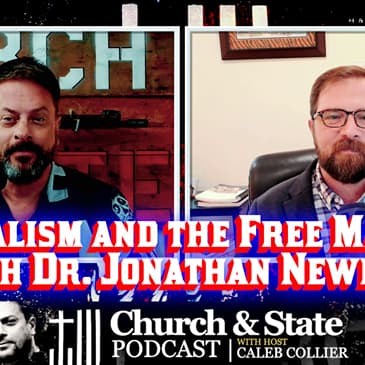
[00:00:38] Today on Church and State, the difference between the free market and capitalism with Dr Jonathan Newman. Hello Christian Patriots and welcome to Church and State where we drive morality and religion over tolerance and apathy. And I'm your host Caleb Collier, once again your favorite far-right shock jock. And the show that talks about politics and religion, Jesus Christ is our referee so it's always nice and clean. Real quick point you to the website churchandstate.media. Fill out this form for us, get our newsletter. It's got a lot of really interesting stuff in it. You're also going to bypass a lot of the censorship that we deal with.
[00:01:07] And I personally call every single one of you who fills this out. Also while you're on the website check out our most recent episodes. We continue to bring amazing guests, a lot of hard-hitting topics, a lot of subject matter that you're really not hearing anywhere else. So please share it around. Also check out the featured guest page. We've had some incredible people join us over the years. Every single one of those you click on the name, it'll bring you right to the episode. Of course I always point people to the Ron Paul. That was definitely a Wayne's World moment for me.
[00:01:37] We're not worthy as Ron Paul gets on the screen. So check it out, share with friends, family and neighbors. Also do a little bit of shopping with us. Check out the great affiliate programs that we have. These are all companies that are liberty oriented. They're great companies. They help support us. And every one of those you can use the promo code CHURCHANDSTATE. Many of those bring a discount. All help support us. And speaking of support, you got to hit the donate button for us ladies and gentlemen. Massive expansion. Picked up by so many different networks. People tend to like the show it seems.
[00:02:07] But we're already part of NRB TV and Prepper Broadcasting Network and OBBM and Faith and Freedom Television and so many others. And now getting pitched nationwide to be syndicated on AM FM radio. We're growing. And we continue to grow. But that requires money. So if you like the show, please hit the donate button. Lastly, if you want to get a hold of us, CHURCHANDSTATE1776 at PROTON.ME. With that, let's go ahead and get this episode started. Now, I am very excited to bring Dr. Jonathan Newman. He's a fellow at the Mises Institute.
[00:02:37] He earned his PhD at Auburn University while a research fellow at the Mises Institute. He was a recipient of the 2021 Gary G. Schlarbaum Award. I'm probably butchering that. To Promising Young Scholars for Excellence in Research. He's an author, a researcher, and we're going to be talking about free market versus capitalism. Dr. Newman, thank you for joining us on Church and State. Hey, Caleb. Thanks for having me. It's good to be here. Yeah, absolute pleasure. I always love getting giants within the libertarian movement on.
[00:03:07] I just actually had Spike Cohen on the show just the other day. So yeah, I love bringing on my fellow libertarians to discuss the free market, discuss solutions that actually work. Yeah, yeah. I think the liberty perspective has a lot to offer. You know, a lot of people criticize libertarians for being irrelevant, for not having good solutions, for, I mean, one possibly good criticism is lacking political power.
[00:03:35] But I think what a lot of them miss in those critiques of this liberty perspective or libertarianism is that we've been right about so many different things, especially over the past few decades. Like if you look at what happened during COVID, the people who are coming from the libertarian perspective, they were the ones who were skeptical of government involvement. They were the ones who were skeptical of the lockdowns and closing schools and the vaccines and everything being top down.
[00:04:03] If you look at recently what's happening with government spending and debt going out of control, the libertarians have been talking about this for a long time. So I think if you look at our record, you see that we have a good understanding of the way the economy works, how government distorts the economy. And I think it's worth taking a deep dive, look at some of the big works, look at some of the big authors. Yeah, it's definitely worth a thorough examination.
[00:04:32] And if you like liberty, you know, think your local libertarian, because we're out there and we're active. And, you know, the old meme of we're secretly plotting to take over the world and then leave you alone. You know, I mean, that's really where we're at as libertarians. Yeah, really, the basic, you know, fundamental idea behind libertarianism is what you just said. It's that, you know, people should be free to make their own choices. And of course, that's the limitation on that is other people's rights.
[00:05:02] So it's a right. It's a rights based framework. We have we have property rights and we own our own bodies. That's really the fundamental starting point. But then that that's consistently applied across the board. So we don't just apply it to, you know, regular, ordinary people.
[00:05:20] But that also applies to people in government, that if we if we don't have a right to steal from other people, then that means if you put on a badge or if you sit in a certain office in government, you also don't have that right. So it's a it's a consistently applied philosophy and it makes a lot of sense. You need to tell. Oh, go ahead. You want to talk about, you know, free markets and capitalism. So I come from a particular school of thought and economics called the Austrian School.
[00:05:49] Our headquarters is here at the Mises Institute in Auburn, Alabama. And you were talking about socialism and capitalism. So maybe I can just give a preview of what does the Austrian school have to say about the difference between free markets and socialism? What what's so great about capitalism? What's so great about free markets? And why why is it that socialism is destined to fail? We're we're all very familiar with certain critiques of socialism.
[00:06:15] So one very famous critique is based on the incentive problem. Like if we're all going to get paid the same, then why who would do the dirty jobs who would do the dangerous jobs? It's like if we're all going to get paid the same that I want to be a food critic right now. That's the job that I want in the socialist utopia. And so who would have an incentive to to learn to be a brain surgeon or who would take out the trash who would do those sorts of jobs? And that's that's a fair critique. It makes a lot of sense. It sort of hits us on a on a fundamental level.
[00:06:44] We can understand that, hey, in order for us to provide for one another in a market economy, we need to have an incentive. We need to be paid more to justify going to school longer or to do risky jobs, something like that. So that makes sense to us. But when the socialists actually have a comeback, they have a rebuttal to that critique. And they say, no, when when we establish socialism, there's going to be a new socialist man.
[00:07:15] Human nature itself is going to change such that we're all going to be other caring. We're going to care about the good of the community over the good of the individual. And so this incentive problem, it's it's a non issue because there's not going to be an incentive problem. Everybody is going to be willing to do what they need to do to to help the good of the of the community. OK, so that's where Ludwig von Mises came up with a great response, another critique of socialism.
[00:07:44] And so what Mises said is like, OK, fine, you can I think I think that argument is dubious at best. Like, I don't think that you're actually going to change human nature. But what he pointed out was that even even if you grant that argument, a socialist central planning board doesn't have market prices. So in all of the different versions of socialism that have ever been dreamed up, you know, there's a bunch of different flavors of socialism.
[00:08:09] Ask it, ask one socialist their definition of the ideal socialist utopia and they'll say one thing and ask another one, they'll say something else. So it seems like it seems like whenever they see a failed socialist state, they just say, oh, it's because I wasn't in charge. It's because they didn't they didn't use my flavor of socialism. But one thing that's common to all of these versions of socialism is that they abolish private property in the in the means of production.
[00:08:38] So like all versions of socialism say we're not going to allow people to own the means of production. This is something that has to be collectivized, has to be under the under the management of some central planning board or some other depending on the flavor of socialism. So what Mises said was that, OK, if you don't have ownership of the factors of production, that means you don't have exchange for the factors of production. And if there's no exchange, then you don't have market prices.
[00:09:05] And if you don't have market prices, then you can't calculate the costs of production, which means that you can't you can't make rational decisions about what to produce, how to produce it, how long the production projects need to be, what what colors shoes need to be and clothes need to be, what quantities of different food items need to be produced. And so like you can't make good decisions about those things in a way that minimizes the opportunity cost.
[00:09:31] And so if I'm losing people here, what that means is we want to economize our resources, we want to use the resources that we have at our disposal that God has given us. We want to use those resources in a way that isn't wasteful. We want to we want to produce the things that people want and need. And we don't want to produce the things that are less important, because if we use steel to make cars, then we can't use that same steel to to make, I don't know, railroad tracks.
[00:10:01] Right. So everything has an opportunity cost. And that cost minimization that happens naturally in the market economy, that's what that's what happens when we allow market prices and entrepreneurs to use a profit loss signal to arrange production. But a socialist central planning board doesn't have that. They just they don't have that information. They don't have the market prices. And so that's why socialism is destined to fail. It's not a matter of just human nature.
[00:10:31] It's not a matter of getting the right people in charge. Even if you had the best, brightest, even benevolent people in charge at the central planning board, they still wouldn't be able to come up with the right production plans. Yeah, I mean, absolutely. It's a great explanation of why socialism is destined to fail. I recently had a guy on social media come on and attack me. He was a communist and he said communist is the best system of government. And I said, can you point to a successful communist nation?
[00:11:00] And he said, well, true communism has never been achieved. And I said, then how do you know it's the best? Yeah, like I mean, the idiocy of some of these people, they always claim exactly what you said as that. Well, if I would have been in charge or, you know, that's not real socialism. And it's like, how long are we going to continue on this failed experiment? There's a great quote from Mises and we actually we put it on a T-shirt. It's so good.
[00:11:26] I don't know if I can remember it exactly, but it's something to the effect of every socialist is a dictator in disguise. And that's because of what you were just mentioning. If they these people who are convinced of socialism, they think that all of the experiments in socialism, the reason they failed is because they didn't ask me.
[00:11:48] Like if I were in charge, then I would be able to design this perfect country, perfect utopia, perfect economy where everybody's equal and everybody's happy and super high standards of living. And so that's that's the problem with it. And so what Mises was trying to convey in that little quote is that they're basically just saying, I need to be in charge of everyone. I need to be the dictator. But I mean, there's no there's no qualifications. They don't have the theory to back them up.
[00:12:18] And as we've pointed out, they don't have the experience to back them. I mean, the Soviet Union fell. Venezuela is a failed state. You can see the difference between North and South Korea from space. Like if you look at satellite imagery, North Korea is in complete darkness and the people are trying to flee. Right. They're trying to go anywhere besides North Korea, whereas South Korea, which has more of a market economy there. They're well lit.
[00:12:48] Right. Which is a good indicator of standards of living there. I mean, there's other examples to look at Cuba. People try to escape Cuba. So if if we can put socialism in practice in a small island country and say, go ahead, try try out your theory, see if it works, then you would think that people would want to stay there if it was working well. But instead, people risk their lives to get on these shoddy little rafts to try to get somewhere else, hopefully to Florida. But a lot of them try to do.
[00:13:16] And so whenever you see socialism tried or communism tried, you see people trying to flee. Another great example is the Berlin Wall. So the Berlin Wall wasn't put up to keep people from entering some socialist utopia. It was put up to keep people from fleeing. So it's a bankrupt idea. Socialism is a bankrupt idea, both in theory and in historical experience. Yeah. And the argument, you see this a lot from the conservative side.
[00:13:46] You know, if you like socialism so much, go there. And, you know, the argument is valid. Like to all these Americans that are enamored with socialism, the rise of the DSA. You know, it's you could go to one of these socialist countries, but they don't do that. They just want to implement it in their own nation. And I don't know, dance upon the ruins, I suppose. Now, a lot of them, I do got to bring this up because a lot of them will point to the Scandinavian countries as successful socialist countries.
[00:14:15] But that's not actually accurate, is it? No, it's not. One extra point that I'll add, what you were just saying, it's really interesting that in a free market economy, if we have any semblance of freedom, then the people within that area are actually free to try out socialism. Like every socialist in the United States is completely free to start their own socialist commune.
[00:14:43] Like if you can find enough people to find to found some unincorporated town somewhere and you're going to try to run a socialist experiment there, you're totally free to do so. But that's not allowed at all under capitalism, under free markets. So it just goes to show that it's a very lopsided sort of system where under free markets, you're free to try something like that out. But under, you know, Dr. Neiman, you don't know this about me.
[00:15:10] I was actually born in a communist Christian hippie cult where they practice that, actually. We all lived in the same house. We all had a common purse. And you know what? It failed. I know you're shocked by that, but it failed. Surprising, right? Oh, so you've got some personal experience there. I do. You were asking about Scandinavia or the Scandinavian countries.
[00:15:34] Yeah, a lot of socialists like to point to them, to those countries as a good example of socialism working. But I think you're right that it's not socialism. They haven't abolished the private ownership of the means of production. And so it's not socialism. Like the most that you can say is it's a very heavy welfare state. It's a they've got it's liberal democracies with lots and with a huge social safety net. That's that sort of thing.
[00:16:04] And the people pay for it. Right. So there's a huge amount of taxation, like half their income, maybe even more goes to support that sort of thing. And the other thing about the Scandinavian countries is that they had a very long history of free markets, which means that they were able to build up and accumulate a bunch of capital.
[00:16:25] And so to the extent that the government gets involved and to the extent that they're wasting resources through these social programs, they're able to do that for a while because they've accumulated so much capital. That's actually why the Soviet Union was. Well, it's one of the reasons why the Soviet Union was able to last as long as it did. So like if we have if we have this argument against socialism that is destined to fail, then why didn't it fail on day two?
[00:16:55] Right. That's a good question. And the answer in the Soviet Union case is that they had some capital already built. They already had some fact some factories built. They already had raw resources that had been pulled out of the ground. They already had some some food that had been stockpiled. Right. So they were able to eat into that while they're wasting their resources. So it's destined to fail, but it's going to take some time.
[00:17:20] But the other reason why the Soviet Union was able to last as long as it did and why heavily interventionist countries like the Scandinavian countries that you mentioned, the reason why they're able to last as long as they do is because there are little islands of socialism in a sea of capitalism. So they can rely on global markets.
[00:17:43] So, yeah, maybe they're not doing so good at producing their own food, but they can rely on the production in more capitalist parts of the world to to provide food and other resources, automobiles, computers, all that sort of thing. So so even even in the case of the Soviet Union, Scandinavian countries, they're able to rely somewhat on global trade, the existence of market economies elsewhere, market prices elsewhere.
[00:18:07] And also because they've built up a sizable capital stock that they can eat into for a little while. And one other note that I have to make in reference to the Scandinavian countries is a lot of their welfare comes directly from the fact that they have a lot of oil, the Dutch oil. Right. You guys are familiar with this to the audience. A lot of the welfare programs are being funded by their oil. I'm sure the environmental socialists just love that one.
[00:18:36] Yeah, I mean, that's that's what I was trying to say. I didn't have a specific example. That's what I was trying to say with this built up capital stock. So like they they have resources that they're sitting on that they can that they can use for a time. But but we know just based on economic theory, we know that whenever the government's intervening in the economy, whether it's something that sounds nice, like unemployment checks or whether it's something that's obviously wasteful, like some big bureaucracy that shouldn't exist.
[00:19:03] We know that they're distorting the use of those resources. And so in the case of pure socialism, they go very, very far in one direction and they're destined to fail. But you can you can sort of trot along. You can limp along, I guess, if you if you're somewhere between like a pure market economy and pure socialism. I would categorize the United States that way as well. So we don't have a pure market economy.
[00:19:32] We have a huge amount of government intervention and health care and we have heavy taxation. We've got a government control and management of education system. The U.S. government's hands are in basically every sector of our economy. And that's to our detriment. I would completely agree. And perhaps this is a great point to our place to to transfer the conversation to the capitalism versus the free market discussion.
[00:20:01] I think we've proven that socialism is going to fail. So we don't want to bring that to America's shores. But is there a difference between capitalism and free market? Well, that sort of depends on the person that you're you're asking and how they define those terms. The term capitalism was actually invented by Karl Marx, who he was he was the guy who invented communism. And he meant that as a derogatory term.
[00:20:29] So like under communism, the central idea, the most important thing is is the community. So communism. But under capitalism, all the income flows to the capitalists. And so he was trying to make a point about the basis or the structure of this sort of system. It's all based on capital as opposed to labor and the working class and the community. And then what we usually mean by free markets is that it's free from government intervention.
[00:20:57] So we can talk about like unhampered markets and hampered markets. An unhampered market is one where buyers and sellers are free to trade with one another. So we have voluntary exchange. They find market clearing prices and we're making the best possible use of those resources. And so, I mean, I'm not really sure where you're coming from with that question about free markets versus capitalism. But there's that's the first thing that I think about when when somebody is asking me, what's the difference between those two? Sure.
[00:21:26] I think the the issue with capitalism is more of cronyism, which is certainly what has been applied. Perhaps there was, you know, really not much of a difference between capitalism and the free market. But I think in America, as you pointed out, as we started this part of the discussion, is that the government has intruded upon everything. And now we see a crony capitalism where it's benefiting the high ups, the capital. Right.
[00:21:54] It's going to the CEOs of Merck or whoever it is that the government is in a partnership with. It's almost honestly a type of fascism. Yeah, I exactly agree with you. So when when somebody says that they're a proponent of capitalism, they usually don't mean that they're a proponent of cronyism. But a lot of times, especially critics of the free market perspective or critics of libertarianism, they view capitalism in that way.
[00:22:24] They equate capitalism and free markets and cronyism. They think that if you have capitalism, then that must mean that you're OK with government bailing out companies, bailing out banks, providing huge subsidies to certain sectors, picking winners and losers. But that that's not what proponents of free markets want.
[00:22:43] So free defenders and promoters of the free market are just as much against cronyism and the government handing out favors as as they are to any other sort of government intervention. So it's a lot of people think that people who are in favor of of capitalism, even if they use that term, they think that they they're just in favor of big business. It's like profit is the only thing that matters.
[00:23:08] And what we need are we just need corporations to manage everything and corporations to be successful. But that that's not the point. That's not the point of defending free markets. The point of defending free markets is actually the opposite. In a free market economy, the consumer is the boss. The consumer is the king. They're the ones who decide what what to buy, what not to buy. So they're the ones who decide which businesses succeed and which businesses fail.
[00:23:36] And if a business grows because it's serving consumers, it's providing low cost goods that consumers want and need, then that business, that entrepreneur that owns the business will be successful. They'll be profitable. But you can't talk about this profit system without forgetting about the loss side as well.
[00:23:58] Losses are an essential feature of the of the free market system, because that's how consumers tell entrepreneurs, businesses, we don't like what you're doing. You're taking factors of production and you're wasting them. You're taking these inputs, these resources, and you're wasting them on things that we that we don't want. Right. So there's there are better uses of those sorts of things. And so to say that to say that we're in favor of the profit system misses that part.
[00:24:27] And people will think that, oh, you just you're in favor of profits. That means that you're OK with government bailing out losers. And I just think, no, absolutely not. Like, I think that the banks during the 2008 crisis, they should have failed. They should have done the bailout. Same thing with the auto manufacturers. So like this, they should have failed. They made the wrong choices. They misallocated factors of production. They should have been liquidated. And sometimes sometimes that sounds heartless.
[00:24:57] I mean, it doesn't sound as heartless when you're talking about big banks and big auto manufacturers. But some some people will hear that and they think, oh, you're OK with people failing. But if you think about what happens when a business fails and is liquidated, it's not like those resources go away. It's not like the labor disappears. No, those things just get bid away to businesses and entrepreneurs who have a good idea about what to make in a profitable and productive sort of way.
[00:25:25] I 100 percent agree with you on that. There's nothing heartless about the free market. And I also want to add, I really appreciate the fact that you brought in corporatism, because that's another thing that that capitalists, those who claim to be capitalists anyway, often fall for. That it's all about the profit and that the businesses are going to make the best decisions for those around them because they're all about the profit. That's simply not the case.
[00:25:51] And I think that's probably the bigger difference between what is now capitalism versus the free market is the free market is the free market is just, hey, you have a product. I have I could I could I could trade you for another product. I have what's been accepted culturally as as as coin as money that I can trade you with that. You know, that's the free market. And I love the idea of look, the people are in charge. Once again, we dictate. Do we want this product? Is this product too expensive?
[00:26:21] We're going to determine whether or not that entrepreneur, that that product is going to be sought after if they're going to be successful. I think that honestly, as I as we're exploring kind of the differences here between capitalism and the free market, I think that really is it in a nutshell. Yeah, I'm glad you brought up money as well, because that's that's another area that's huge. You're talking about people like we culturally accept what to trade with, like what medium of exchange we're going to use.
[00:26:51] That's that's one area that has been completely dominated by the government. Like if you go back to 1913, especially you see the establishment of the Federal Reserve. You see that they took over the banking system. They FDR confiscated everyone's gold and made gold ownership illegal. So people couldn't use gold coins or redeem their banknotes for gold anymore. And then we had the Bretton Woods system put in place after World War Two.
[00:27:19] So only foreign governments and foreign central banks could redeem their green pieces of paper for gold. And then Nixon ended that in 1971. So now we just have a pure fiat system where the dollar is not backed by anything. And that's that's there's, you know, a few facets, a few aspects, a few paths we could go down here.
[00:27:40] But probably the simplest, most basic thing that I can point out here is that it means that the government has a money printer behind it, which means that there's really no limit on how big it can grow and how there's no limit on its scope either on how many different areas it can get involved in. Because in the past, under a gold standard, when you could actually redeem green pieces of paper or banknotes for gold, that was a hard constraint on how much the government could spend.
[00:28:10] They were constrained by the gold in existence. They were constrained by how much they could collect in taxes. And they were constrained by people's willingness to lend to Uncle Sam. Now, I got to pause you real quick, Dr. Neiman. I apologize, but we're hitting that hard break. But ladies and gentlemen, we're going to come back. We're going to continue this really great conversation. Hey, this is Caleb Collier with Church and State. I'm here to tell you about Hunter's Blend Coffee. I got to tell you, I absolutely love this stuff. I'm all about the dark roast.
[00:28:38] Hunter's Blend Coffee, black powder. Doesn't that just sound like deliciousness and rebellion? I got to tell you, in America, we don't drink tea. No, we drink coffee. It's the food of the gods, and I endorse and support Hunter's Blend Coffee. I got to tell you, it tastes like freedom. So I need you to go over to churchandstate.media, scroll to Hunter's Blend Coffee, and use the promo code CHURCHANDSTATE to help support us.
[00:29:06] When you go to huntersblendcoffee.com, not only will you be getting a great cup of coffee, but you also, if you use the promo code CHURCHANDSTATE, be supporting Church and State in our dogged pursuit of truth. And we are back, and thank you for staying with us. You're over at churchandstate.media. And we're going to go right back to our guest. I do have to plug one of our awesome affiliates, and I'm going to go to mark37.com. Look, we're talking about libertarianism. We're talking about the free market. And for those of you that consider yourself a warrior or you're in this fight for liberty,
[00:29:34] why are you using the comms devices of our enemy? Why do you use an Apple phone or a Google phone when you know full well that they're spying on you? And you know how you know this? Because if you talk around your phone, you're going to get advertisements for whatever you were talking about. Get a ghost phone. Get something that's operating off of Graphene OS. It's an open system. Any libertarian should appreciate that. It's an open system that anybody that has any technical savvy can go in and say,
[00:30:03] yes, this product does exactly what it says it does. So if you're tired of big government, the different businesses that are all spying on you, go get yourself a ghost phone. Go to mark37.com. Use the promo code churchandstate for a discount, and you'll help support us. And one more time as a reminder, please hit the donate button for us. Please keep conversations like this happening. They're so important to defensive liberty. All right, with that, let's go back to our guest, Dr. Jonathan Newman.
[00:30:31] And I did have to interrupt you, sir, so I apologize for that. It's the nature of the beast. But please continue with what you were saying. Yeah, we were just talking about the way that government has taken over money and banking. And so I walked through like a little short history of how they've done that with the Federal Reserve and FDR confiscating gold. And then there was the Bretton Woods system. And then Nixon ended the Bretton Woods system. And so now we have a pure fiat money where the dollar is not backed by anything.
[00:31:01] And I was talking about how this has allowed the government to grow really without any sort of limit. So under the gold standard, under the older system, the government was limited by how much gold was in existence. They were limited by how much they could collect in taxes. And they were also limited by how much people, ordinary people were willing to lend to the government. Whereas now there's no such constraint. Yes, the government still collects taxes. Yes, they still borrow from the public.
[00:31:30] But now they have this Federal Reserve that buys up their debt for them with newly printed money. So there's really there's no limit to how much the government can can spend. I know we we we point to the huge debt. The national debt recently went over 40 trillion dollars.
[00:31:49] But the reason they're able to do that and the reason why people are still willing to lend to the government is because they know that the government can't default on its debt, at least not nominal terms. They can default in real terms through inflation. So when they print up money, it allows people to bid up prices of goods and services.
[00:32:09] And so those those fixed incomes, whether you're on Social Security or whether you're receiving coupon payments by lending to the government, those things buy less and less as the as the money depreciates in value. So this is probably one of the one of my most important issues.
[00:32:29] One thing that's near and dear to my heart is the way that the U.S. government has taken over money in banking and it has allowed the government to grow to huge proportions like the founding fathers. Would they would be shocked by by how big our government is and how many different areas that it's involved in. And it's all because of its monopoly over money.
[00:32:50] Yeah, our founding fathers would either be trying to lead a revolution or more than likely probably be imprisoned because they would be very, very angry with the condition of this once great republic that that they fought so hard to give to us. And where that posterity that they talked about and boy, have we mismanaged what was given to us. You know, as far as the money issue goes, you know, this is something that the audience should be feeling right now.
[00:33:18] You know, yes, maybe they haven't studied it like you have, but they're feeling it. And you're talking about that inflation. And every single time somebody goes to the gas pump right now, they're feeling it. Every single time they go into the grocery store, they're feeling it. People are having to make really hard decisions about can I afford this? You know, some of some of the things that brought us joy were outright canceling. People are canceling vacations because I can't do it this year. You know, I'm hoping the economy turns. But right now I can't afford something like this.
[00:33:48] And, you know, that people would like to blame Trump. People would like to blame Biden. But the reality is, as you just pointed out, this happened a long time ago. Yeah, it's a system that's been around for a long time. Of course, you know, presidents come and presidents go. But the Federal Reserve, you know, sticks around and they're there to inflate the money supply. You were talking about the pain that people feel at the gas pump and at the grocery store.
[00:34:12] And I think this is the reason why the government is able to get away with inflating. So if you think about two different ways that the government could raise money to start some new program or fund some new department, some increase in the size and scope of government, one way that they could fund it is with taxation. They could increase tax rates. They could send tax collectors.
[00:34:40] And this would be immediately painful to the citizenry. This would be immediately painful to taxpayers. And they would see exactly that they are paying for this, that it's coming at their own expense. So this new program, whatever it is, it's coming at their own expense. And so there would be a lot of pushback against this new program that's being proposed or being put in place because they see the increase in their taxes.
[00:35:08] Now, if you think about another way that the government could finance this new program, they could use the printing press. They could run a deficit and sell debt to the Federal Reserve, and the Federal Reserve buys it with newly printed money. And so how does the public pay for it in this case? Well, in this case, it's delayed and it's complex. So they don't see the increase in their gas prices.
[00:35:34] They don't see the increase in airfare, grocery prices, utilities. They don't see the increase in those prices until later, which means it's harder for them to connect this increase in my expenses to the new program, this increase in spending that occurred. And so it's harder for them to connect the dots there. But also it's more indirect. So it's not just that there's a time delay, but there's – you notice that I had to go through multiple steps. You had to connect some dots there.
[00:36:03] And so what people – what some people often do is they will – they'll blame the gas station owner for high gas prices or they'll blame the grocery – Elizabeth Warren did this. They'll blame the grocery store owners. One of the lowest profit margin industries in the United States, blame them for being too greedy, and that's what's causing prices to increase. But since it's proximate to where you're paying the higher prices, it's easy for people, especially people on the left.
[00:36:33] That's an easy narrative. That's an easy bit of propaganda for people to swallow. It's like, yeah, it's not the government. It's not their fault. I'm paying high grocery prices. It must be the grocery store owner that just decided to be greedy all of a sudden. Now, one thing that that narrative can't explain or one thing that they don't talk about is they – whenever grocery prices come down or gas prices come down or in the past couple years, egg prices came down,
[00:37:02] they don't say, oh, I'm so glad the egg farmers, the chicken farmers that supply the eggs, I'm so glad they decreased how greedy they are. I'm so glad that the grocery store owners aren't as greedy anymore. I'm so glad the gas station owners aren't as greedy anymore. But that's – if you wanted to consistently apply that narrative to changes in prices, you would have to make that claim.
[00:37:24] You have to say if increases in prices are due to an increase in greed, then you'd have to say decreases in prices are based on a decrease in greed. But like why would – what explains this increase in decrease in greed that's resulting in higher and lower prices? It seems to me that the better explanation is it's a problem with the money. It's a problem with government spending, and it's a problem with the Federal Reserve system that we have.
[00:37:53] I think that's pretty obvious. It's a great point, and I appreciate you bringing it to the audience. And now you have these elites right now within the Republican Party, but it happens on both sides. Really, it's a uniparty to me. But they're saying – if people are saying beef is too high, well, then eat chicken, eat eggs. And it's like it's Marie Antoinette all over again. Like let them eat cake.
[00:38:19] I just cannot understand the disconnect and why people on either side of the two-party system are defending this. Well, I think the reason why is because they know that it's essential for the government to grow in size and scope. So there's really no political wherewithal to attack this system that's providing them with the ability to spend as much as they want. So you don't see much pushback on the Republican side.
[00:38:47] There's a few – like Thomas Massey, he would criticize – Ron Paul as well, who was a guest on your show, who will criticize the Federal Reserve. But overall, both Republicans and Democrats, they sort of leave the Fed alone. They leave the government's monopoly over money and banking alone. And I think it's because they know that that's how Uncle Sam's bills get paid.
[00:39:08] So there's not really a lot of – even though I think it would be politically popular for Congress to actually stand up to the Fed. You know, Congress is the one that actually gave the Fed its authority. And since then, they've just sort of taken a step back and let the Fed do whatever it wants. They don't really exercise much oversight of the Fed, even though it's perfectly within their authority to do so.
[00:39:35] The Congress people will say, oh, we don't want to threaten the central bank's independence. The Fed is independent, and so it needs to do what's in the interest of the American people. And if we get congressmen to exercise some oversight, to ask some hard questions of the Fed chair and the committees that are setting monetary policy decisions, then they're going to make the wrong decisions. I think that's bogus. Like, we don't accept that for any other department or agency in the government.
[00:40:03] It's like, no, that's the way that the people have any sort of semblance of control over what their government is doing. And so if you have an independent agency that isn't even – Trump tried to fire one of the Fed governors early – I think it was earlier this year. And even the Supreme Court – there was a great dissent by Clarence Thomas, by the way.
[00:40:28] Even the Supreme Court sided with the Fed saying, oh, no, we can't let the government – we can't let the president exercise any sort of control over what's happening at the Fed. And so I'm just thinking, like, okay, what does it take for the people to have any sort of say over what's going on at the Fed? What if people don't want 2 percent price inflation? That's their target, by the way, even though we haven't had that for years and years. What if people don't want that to be the Federal Reserve's target?
[00:40:57] Congress isn't willing to step up to the plate. Apparently the president doesn't have any control over what's happening day to day at the Fed. And so what we're left with is just this system that is rogue and is completely disconnected from any sort of oversight by Congress, the president, and the people. It's terrible. And then we have this political theater of the president picking the chair and then getting ultimately appointed. The chair is not even the leader, guys.
[00:41:25] Like, there's people that you don't see behind the scenes that are actually calling the shots. So it's all theater to me. Dr. Nimi, you ever feel like you're living in idiocracy or you got President Camacho doing the State of the Union saying things like, people don't want no jobs. People want money. So I'm going to give you all the million dollars. Like, it seems to be happening in real time. Yeah. Unfortunately, idiocracy is becoming less and less of a comedy and more of a tragedy as the years go on.
[00:41:55] I remember watching it a few years ago thinking it's funny. And now I think about what happens in that movie and I just think, oh, how's this sad? It seems like a lot of this stuff is coming true. You were talking about the president appointing the Fed chair. And you're right. The chair doesn't unilaterally control the Federal Reserve. Although they do have more say than the typical FOMC member over what happens with monetary policy. But they're not the only one.
[00:42:24] So you're exactly right about that. And you're also exactly right that there's a lot of theater that goes on between the Fed and the president and the Congress. And it truly is theater. In fact, I like to use the term kayfabe, which is a term in professional wrestling. You know, they show the drama between the two different wrestlers and they hate each other and they're calling each other names. And so they refer to that as kayfabe.
[00:42:49] I think whenever you see any sort of sparks flying, any sort of fireworks between the president and the Fed, like what we saw with Trump and Powell, I consider that in the same sort of way. It's a false drama that makes it look like the Fed truly is independent, that they're trying to flex their own authority.
[00:43:12] When really the Fed, and Congress knows this, the Fed is there to be the government's money printer. Whenever there's any sort of crisis, whether it's an economic crisis or what we saw during COVID with the pandemic, whenever there's any sort of big increase in spending that's spurred on because people are scared about something, then the Fed is there to print the money for the government. So it's not independent. It's not independent in practice.
[00:43:41] It's only independent in rhetoric and through this kayfabe that goes on, this political theater. And so a lot of people, they misattribute this term independence to the central bank. And they say the central bank is independent because they don't favor one political party over another one. But you yourself said it's a uniparty. It's like, well, I mean, what does that even matter?
[00:44:07] What really matters is whether the Fed is actually pursuing monetary policy in a way that's providing a sound money, that's not causing business cycles, not causing financial crises. They're not helping the Treasury and other agencies bail out big banks. They're actually doing things that would be in the interest of ordinary citizens, not necessarily in the interest of the government.
[00:44:33] And we've seen throughout the Fed's history, they're always there to back up the government and not ordinary people. All right. So I so appreciate you coming on your time here, your work, obviously. I do have one last question. It's a personal one for me. I need you to settle something for me because I've heard it said both ways. It seems to me like kind of the epoch times or the epic times. Is it Mises or Mises? Oh, it's Mises. OK.
[00:45:04] People say it all different ways. It's spelled M-I-S-E-S, but it's pronounced Mises, Ludwig von Mises. OK, because I've heard numerous people say Mises. So Mises Institute, we're bringing up the website right there. You can see Dr. Jonathan Newman right there. But, Chris, if you could go to just the homepage for me. Look, guys, this is a great resource for anyone who is liberty oriented.
[00:45:30] You know, if you're a constitutionalist, a conservative, a libertarian, this is a great institute that I really want you to get familiar with. Dr. Newman, tell people why they should go to your website. The Mises.org website is incredible. It's been huge for me when I was a student and when I was a Ph.D. candidate. Everything that's published by the Mises Institute is available for free online.
[00:45:58] And we have events for students and events for other people. Students are able to do everything that we do for free. So like if a student wants to go to an event, they can apply for a scholarship. We exist to provide all of this information for free. So we exist to just promote Austrian economics. And so we don't put up paywalls. So any book by Ludwig von Mises or Murray Rothbard that you want to read, it's available there on the website. We've got tons and tons of YouTube videos.
[00:46:26] We've got daily articles that go up about current events. It's just a fantastic resource. One other plug that I'll make regarding the website. If you're a student or even if you're not a student and you're interested in learning more about Austrian economics, you'll see there at the top there's an academy tab. So if you go there, you'll see we've got a lot of different courses available for people to take, again, for free. And it's courses for beginners. We've got stuff on that's like at the high school level.
[00:46:54] We've also got stuff that's for undergraduates and even graduate level and all sorts of topics available for courses for people to take. So I highly recommend you check it out. It's a wonderful website, ladies and gentlemen. I love this. I've been on this so many times over the years. It's a great resource. I actually had not checked out the academy before, but I'm going to recommend it because I think every American should have a little bit of a better understanding of economics.
[00:47:21] And then perhaps we might, I don't know, implement some change in the government if we understand economics. Dr. Newman, it has been amazing having you on as a guest. I've got to go ahead and close this out. If you hold on one more minute post-production to say goodbyes, I'd appreciate it. But again, thank you for all your work and for your time here at Church and State. Yeah, thanks for having me on. It's been great, Caleb. Absolutely. All right, ladies and gentlemen, there you go. Austrian economics. Who knew that there was another option out there?
[00:47:48] I know you've been living under a system, honestly, that has been failing you. It's been stealing your wealth through inflation, through a dollar that is completely fiat. Go get some education, some knowledge, and that will make you a soldier in this fight for liberty. I cannot recommend it enough. Mises Institute. Go check it out. Church and State is brought to you in part by Colonial Life Spokane. Independent Agents, Finders Insurance, and mark37.com. I'm Caleb Collier. I was born for a storm.
[00:48:52] Welcome to the fire. Enjoy the benefits. Enjoy the benefits. And it'll also have a little bit of fun when going to the bathroom. I need you to go to best365labs.com and use that promo code CHURCHANDSTATE. You're going to get a discount. You'll also be helping to support Church and State and our pursuit of truth. Hey, this is Caleb Collier with the Church and State Podcast. Ladies and gentlemen, I want all of you to go to Galileo.com. You need to stay connected no matter what comes our way.
[00:49:18] Whether it's government intrusion or a meteor falling from the sky, Galileo has you connected. As a Marine veteran, I can tell you that communications is essential. Galileo has you connected. Whether it's worldwide coverage, uncensored content, or real-time alerts, Galileo is going to make sure that you're connected with your friends, family, and neighbors. Just head on over to churchandstate.media, scroll over to shop, and hit galileo.com. Make sure to ask them for a free bibby stick, and make sure to use that promo code CHURCHANDSTATE.
[00:49:47] Hey, this is Caleb Collier with Church and State, and I want to tell you about a great product, Liberty Cigars. I know for myself, there's nothing grander than sitting around a campfire, having a great theology discussion with a group of men while smoking a cigar. That's why I love Liberty Cigars. Every cigar has a story to tell. Not only are you going to be smoking the finest cigars on the market, but you're also going to get a history lesson with every single one of them.
[00:50:13] From George Washington to Thomas Jefferson, the heroes of the American Revolution, generals, presidents throughout history. I'm telling you, I absolutely love Liberty Cigars. I need you to go to libertycigars.com, use that promo code CHURCHANDSTATE, you'll get a discount, and you'll also be helping to support Church and State with everything that we do.