Become a supporter of this podcast: https://www.spreaker.com/podcast/prepper-broadcasting-network--3295097/support.
Head to bepreparedsolutions.co/partner/pbn, or use code PBN20 when you sign up to get 20% off their incredible preparedness tools, custom plans, and LOCAL INTELLIGENCE.
STOP THE ADS! Become a PBN Supporter for just $5 a month and get exclusive podcasts just for supporters. BECOME A SUPPORTER
The Prepper's Medical Handbook Build Your Medical Cache – Welcome PBN Family
Join the Prepper Broadcasting Network for expert insights on #Survival, #Prepping, #SelfReliance, #OffGridLiving, #Homesteading, #SelfSufficiency, #Permaculture, #OffGrid solutions, and #SHTF preparedness. With diverse hosts and shows, get practical tips to thrive independently – subscribe now!
Newsletter – Welcome PBN Family
Get Your Free Copy of 50 MUST READ BOOKS TO SURVIVE DOOMSDAY
Support PBN with a Donation
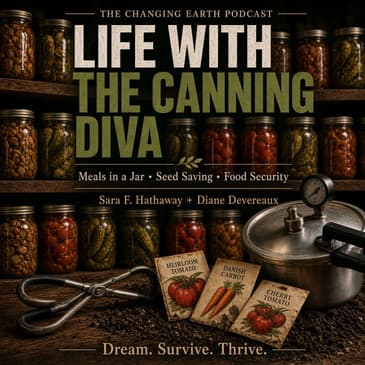
Maybe welcome back to the changing earth podcast with author sarah f hathaway and co-host chen gibson blending survival fiction and fact to bring you entertaining education that will help you dream survive and thrive and now here's your host sarah f hathaway and chen gibson. Hello and welcome back to the Changing Earth podcast. Obviously Chin does not look like Chin today. I have Diana, the canning diva with me. And I hit Chin up about coming on the show and he's like, I don't know if I'm going to get a word in edgewise. I was like, yeah, but you better just stay home tonight, buddy. So Chin's taking a break. But hello, Diana. How are you doing? I am awesome. I'm so happy to be here and I'm well rested and ready to go. Well, we just got really, really overheated at Prepper Camp this year. So you were such a trooper down there camping in the vendors area. I couldn't believe how many bugs exist in North Carolina that wanted to destroy us. That was shocking to me. You know what? It was crazy that... I was probably the only fortunate one. And I'm usually a mosquito magnet. I really didn't have it too bad. But see, we would wait really late to go to bed until it cooled off everywhere. Right. Yeah. That tent. Oh, like it's like a little bit did cool off. Yeah. I was going to say, cause we were so thankful to go back to the hotel room. Yeah. I was even glad we didn't bring the trailer. Cause we don't, you know, we'd have just been stuck inside that box running the AC, everybody miserable. So, um, it was a great time at prepper camp always is, but man, was it warm this year? Yeah. We survived and we're recalibrated. Yes. A month later here. And yeah. Back on track. Oh, We got our dogs back. Everybody's happy. Yeah. So, so the canning diva, where did your, I'm curious where your adventure began with canning. Cause. Well, I haven't heard this story. Yeah. I've always done it right since I was 13 and we moved to Northern Michigan. It just was a way of life. Okay. But then as an adult. Did your grandparents also like cam before you like learn it through the family? Grandma Cole did that she taught us. Um, We lived on a hog farm. We had a two-acre garden, and that was for our provisions. We had 80 acres that were farmed for livestock, and it was just normal. Now, at a younger age, it was our job to do all the picking. So we didn't really get in the kitchen. Mom was always in the kitchen helping and doing. They're like, get up here, kids. We don't need you. We did all the picking and prep work, and then it's like, get away from the stove. Get out of here. But as I grew older, it just became, you know, especially when I got married and my son and, you know, we had land. So I have this big garden. It just it was it was just I went right back to it. But then I had a career in disaster management and I had traveled way too much in 2010. And when, you know, my husband at the time and I sat down, it's like, OK, what what do you want to do that's going to keep you closer to home? Cause I think I traveled 2010 was disaster after disaster. I was gone like 30, close to 34 weeks out of the year. Um, and that was a lot on the family, you know, it's, it's a great career, but not when you got little ones at home and it's just, you know, I had to find something that could blend my knowledge and my passion. And that's how the canning diva was born. So nice. Yeah. Yeah. That's a, that's a smart idea. Yeah. 2010 was like right when I was being inspired by, For day after disaster. So right from the first book, I was in the throngs of finishing it up and everything. So yeah, I could definitely see how that you were a busy, busy gal during that time. Yeah. I mean, I spent 12 and a half weeks in Haiti during, after the earthquake, BP oil spill was that year, the Enbridge oil spill that went in Michigan. Oh yeah. Yep. And you were from Michigan at that time? Yes. That was the closest disaster, but I still had to be on site. So I'd get, it was a little bit easier to go back and forth because it was only about two hours away from my home. But, you know, we're 72 hours on, 24 off. So that, you know, I'd get to come home, but it's still, yeah. You didn't have to rest and do your thing when you're off. Yeah. No. So Hog Farm- You guys were canning meat. You weren't scared of the meats. No, never. No. And we did like, we still used freezing. Like, um, I remember being a kid in the big, you'd get the back of the pig along with all the slices of bacon delivered and we would count those up and free. Yeah. I'm the best bacon ever. Oh, good. So we froze a lot too. Honestly, you know, it wasn't just canning. But, um, You know, even things that I'm teaching again today, like heritage skills, where you're reserving the bacon grease, you're rendering lard and tallow. Right. Just the things that we did normal, that old coffee can, you know, that we'd get. Out from underneath the sink and, you know, that's where drippings were, you know, just things that we seem to have gotten away from. I'm enjoying reminding people like, hey, You worried about seed oils? You don't need all that, you know? Right. There's waste. We never use like Pam or anything like that. We just save all of our bacon grease and the fridge and that goes on everything, you know? And then it doesn't misflavor it or anything. Right. No. Yeah. The one thing though, that my mom did love and loved until her dying day was Crisco. And I know that for baking, cause they got all into that, but it's like nowadays I'm like, Oh mom. I still use the Crisco, but only in my fryer. Oh, there you go. Yeah. So I still use like a real lard in the fryer, even though it's like liquid only in here. I'm like, no, I just pack the heat element in Crisco and then I can still use it there. Oh, that's awesome. Yeah. My mom's pasty dough recipe. specifically calls for, she loved the butter flavored Crisco. So that is the one thing that it's like, okay, we got to make it the way mom made it. You know, she didn't use lard. She was very, you know, funny. But outside of that, you know, it's, yeah, those are things that I carried with me. And it's funny because I had that break in college. Although my freshman year of college, my mom did get me in my own pressure canner for Christmas. Oh, nice. Isn't that funny? Like I still- You know. Here's your pressure canner. Yes. My mom and my mother-in-law have bought, bought me and my husband, both of our pressure canners. So yeah. Cause we did a lot of hot water bath, you know, we are growing up with the tomatoes like crazy. Mom had a whole wall of tomatoes. You know, we were just going off on the tomatoes. And then my husband and I really got into doing the pickles that you had. Oh, which I got to sample, guys. They were amazing. Yeah. Everybody just buys them out. Whatever I have extra, they're just gone as soon as I make them. Actually, I think they saved my life because my electrolytes were so depleted. That's so true. I drank the juice, like all of it. In one gulp, because I was just, my body needed it so bad. So, yeah, I think your pickles saved my life. And it encouraged me to, like, actually eat some of that jar, too. And I was like, oh, wow, I did feel it, you know. Yeah. Yeah, they were a godsend pretty much at that point. I'm glad I brought a flat to give to everybody. Yes. Yeah, so we got into, like, doing that. But I had never really done meets and things like that a whole lot. You know, that was like a danger zone. Yeah, I hear that. Oh, I'm scared. And, you know, what if I get botulism? You have an. A hard time getting botulism. You really have to work at having a dirty kitchen. Screwing it up very well. You're not cleaning your, your vegetables property properly. Excuse me. Um, I mean, you've got to work at making that happen. Like some kind of old meat, some kind of. You're not just going to randomly get botulism from it. Like, Bachelors and spores don't float around us in like, yeah, it's not, yes, they're everywhere, but they're not like, they're not like a fog, you know, that we walk through every day. And most of the time using running water, searing your meat, it's microorganisms and natural foodborne pathogens that we need to be more worried about in home canning. Because those are the things that are going to rot our food. And then it comes right down to processing. And I think a lot of people were afraid to do meat and meals in a jar. It's because they were scared to use the pressure canner. Right. So my husband does the pressure canner. Yeah. I am like, if somebody is going to like have the accident, it's going to be me. And if he has the accident that I can be like, Oh, well, okay. Um, yeah. Cause I'm like the one who cuts my finger or like figures out a way to break things and screw things up. And he taught. Me pretty good though. Right. Or, you know, just always checking the orifices to make sure those are clear. Right. That the seals all look pretty that we're putting the oil on them and whatnot. To keep them, you know, functioning as they should. Right. Right. So, um, yeah, we all, we actually had to buy a new one when we moved out here cause we lost our weight. Oh, see, you can, most of them, you can get a replacement weight. Yeah, we could have, but it was, it was, was it old? Oh yeah. Yeah. I was just, When I teach classes. I remind people, like, you get one weight in the box. I would go right to the Amazon or manufacturer website and order two more because without it, you can't use it. At all. And I would lose mine sometimes. So I always had a couple spares in the drawer, thank God. That's a smart plan, right? Yeah, there's nothing worse. Two is one, one is none. Yeah. You're like, oh, crap. What about, like, grid down scenario? Mm-hmm. And now we have to can over like a different type of flame. Right. Fire. I use a camp chef stove. So it's a dual burner outdoor stove that you can hook up to a propane tank. Right. And I use that when I'm doing like heavy, like I have the 41 and a half quart All-American that'll hold 20 quart jars. Yeah. That's what I have on the table. Yeah. Yeah. Put it out there on that. You know what I mean? I use a fire. It won't even fit on our current oven. It doesn't fit in between the micro and the stove. Exactly. Or be worried about weight. You know what I mean? It's so heavy. Our, our, you know, our residential ranges aren't built for that. So that chef's stove is a, is a, is a godsend. And then I also have a portable butane burner. We were cooking on that at pepper camp. So that can be dual purpose. I've used it in the house and outside because the butane isn't going to disrupt. You have to watch it a little tighter outside because now you have airflow, that kind of thing. No, just no wind zone. Yep. And the camp chef's stove does have what's nice. They do have an air barrier, like a wind barrier. Perfect. But when you use those fire bricks, that seems to kind of help a little bit. And then, you know, just where you position it, know where your wind flow is. Right. No, I love doing that because I feel like it's less in the house too. So I'm not heating with air conditioning. I'm not heating up the house. Right. We've still been getting it in Texas. So yeah, it was a warm day when we had to run that stove for 90 minutes to get our meals in a jar taken care of, right? I hear you. I want to talk about the other one first. I don't want to jump in. I want to talk about the Seed to Table book. Oh, from Seed to Table. Thank you. Right? I want to talk about that one first because this one is a plethora of... so many goodies you've got recipes you've got growing you've got seeding the seeding charts are something beautiful in and of themselves because you know if you haven't folks out there listening if you guys haven't started processing your own seeds you need to start right away and one of the greatest things that I've found about processing our own seeds is that um the plants that do the best and thrive in your environment are the ones you're propagating. So that's why I was like, Oh yeah, Diane. Perfect. Right. Like, yeah. Yeah. Because I mean, there's a seed battle going on. We see it in the news. We're here. We're learning. Consumers are getting more and more frustrated that we know now things are being genetically modified. So they don't produce seed. So we can't regrow it. Seed companies are getting kind of a stranglehold. It's best to do your own heirloom. And then, yeah, you're right. In the book, From Seed to Table, I literally give you every step of what you need to do to cultivate it, to dry it, and then properly store it. Because then you're going to have a continual garden for the rest of your days. And it's so conflicting outside. the news out there of what to do with it, you know, Oh, soak it in water. Don't soak it in water. Do this, do that. And it's easy when you're propagating to just plant them again, because the plant's basically going to take care of itself. But when you have to put them on hold or you want to store them for long-term use as well, there's a little bit more care that goes in there to making sure they can last the long haul. Yes. And that's where those tips are valuable. And then The other thing I really focus on, and I start the whole book with it, and my stepdad taught me this, it's your soil that really matters. And if you don't take good care of your soil, what you are doing to it is eventually what you're going to consume. So the better you treat it and amend it and give it what it needs, sometimes just via crop rotation, which I talk. About that a lot, you're now. Whatever you're growing or whatever's eating that crop, with animals, right? Your cows, pigs, chickens, and then we end up eating them, right? Or their eggs that the soil matters so much. And when you learn to garden without using pesticides and chemicals, and you just let nature do as it's intended, um, you're healthier overall, you know? So, Absolutely. We hit that same struggle here because the houses here, when they build them, they strip the topsoil away. So to like try and put a garden in, we were just up against the wall, up against the wall. We started being able to amend little sections. But for some reason out here in Texas, it's been really hard to find like a good soil that's like a manure type, really black topsoil mix that we can get a lot of. Right. So we finally did with our raised beds. And so those are squared away. But we have the section in the backyard and we've just been burning all of our, you know, any kind of rubbish that comes in, putting our compost there, putting our chicken waste there and just trying to take care of the square so we can nourish it. Yeah. And get some organic material in there to actually like get it back to life. Yeah. And that takes a couple of years because you have Like, especially with chicken poop, you have to allow that to mellow for a year before you can ever plant something there because it's so potent, right? Versus cat manure that you can grow in a whole pile of it if you need to, you know? Right. So, yeah. Next year, I think I'm going to ask the people down the street, can I get some of that horse manure? Get a rototiller and get her all going. Roll it all in. I think we're almost there because we want a big potato patch, you know, and we just really can't do that in the raised beds. It would take up all our space. Yeah, exactly. No, I think you're doing the right things. It's exciting to hear because that's, you know, the book is written for individuals who don't have this huge homestead, right? Right. They could be condo living or city dwellers or, They might be in an HOA in suburbia. You can still feed yourself, you know. We've grown some really big gardens in very little spaces. Spaces. You know, like a 10 by 10. Yeah. Yeah. This one's actually much larger. We were at this house that was in a town, you know, like small. So it was a 10 by 10 space and we were canning and everything out of it. It was, you know, really good. Yeah. So it's just a matter of like. Doing the work. And then yes, in the book I give like canning, dehydrating, freeze drying, freezing. I have freezing recipes and also freezing tips because freezing is a food preservation method, right? It just doesn't last as long, but it works. And then also dry food storage. And then I teach you now that you've taken care of the soil, you've grown everything, you've harvested the food and the seeds, you've preserved it. Then at the end of the book, I teach you how to cook with all of that. And it's about a modifier recipe. So let's say you're online and I get this a lot. Diane, I love this recipe. How can I, how can I make it? Can I use my canned good in this? Or how do I, what's the, you know, ratio if I had dehydrated versus, you know, fresh. To bring it over. Yeah. To bring it over. There was a lady you would have just jammed with at Prepper Camp Grammy, Grammy, Granny Pam. And she did a lot of like how to use your dehydrated powdered foods that you buy, you know, as long-term food storage and how to use those to actually like make cookies and actually do that. So you've just taken it like next level because it's like, Here's how to get all of that product that you made yourself. So you don't have to worry about what's in it. And now how to use that in your recipes. Yeah. How do you use it? And how do you take a recipe you really want to make online and convert it using all of your, your, uh, uh, preserved. Yeah. Yeah. Right. Sorry. I'm like, no, I know. I knew we were going to be today. I was like, that's why Tim was like, Oh heck no. I'm not. even going to do that. It'd be like me and Jordan. I guess they're like, right. So he's over there waving a flag. Can I say something? I mean, then you wait for him. No, he's not saying anything. I don't know. Yeah. Yeah. Okay, we'll get to the pets at the end because everybody loves the pets. But let's talk some meals in a jar. So, crazy good idea. We, on the weekdays, are so busy. Right. And we are just rocking and rolling, like, you know, from morning walking the dogs to go to work, martial arts and everything. And my son's band schedules. I mean, it's just a lot of weekday nights where we're like, OK, we're just going to we can door dash from our house now. It's like we've never been able to do that before because we always lived out in the country. And so it's like, all right, what are we going to do? You know? But I don't want to have, you know, my old martial arts instructor was like, how much do they pay those kids to make your food? Yeah. And you're like, yeah, not very much. Like, do you think they really care about the quality of product that's going into what you're eating? And even worse, like how much does that major corporation pay a, a. over-processed company to pre-make most of it. And then these kids are just heating it up. So you really don't even know what you're eating and you're not getting it in the manner you would. Yeah. And McDonald's serves something like Like 300 million burgers a day or something. And they're not even meat. Where's the cows? Yeah, they're not even meat. Yes. Where are these cows that are making supposedly all this beef that's going to Burger King, McDonald's, you know, Jack in the Box? Like, where are these cows is my question. Yeah. So I'm like, you know, I. In a lab somewhere. Yeah. Yeah. And we were in the habit of buying like half a cow and just, you know, having our own meat. We have a really cool meat packing place in town where you can buy, you know, local meat, all that kind of stuff. So it's like, all right, I need to like set this up better. So we have more healthy dinners as we come in to just rip through, you know, and we have like a menu of like the fast ones, you know, the fast, fast. But then you eat them over and over and over again. And you get food fatigue. You're like, I want to eat this again. Okay. So I did the beef stew out of your recipe. Let me grab that book because this one is really cool, folks. This is the one I was like, Diane, you have to give me this book right now. And see, I'm all tabbed out even. Yes, I love it. Mine's tabbed too. I'm the author of it and I have mine tabbed. Right? I get it, girl. I love it. This is first and then this one. And so, yeah. I'm glad that we talked about using the big pressure canner because I wanted to do two at one set. And I've seen that the recipes are pretty much set up perfectly to be able to do seven quarts at a time, which is perfect fit for the pressure canner. But then if I did two meals, you know, you have to wait for the pressure canner to go up. You have to wait for the pressure canner to come down. And then. But if I was to use my big one again, we could do two meals in one day. Exactly. Yep. That's why I have it too. So everything worked out really good as far as like proportionally and all that. I will just a little bit dial it in a little more. I did have a question about the potatoes. You did like an inch and a half. They're pretty big chunks of potatoes, right? And then they're kind of hard to go in the jar. I've canned just potatoes, peeled potatoes before. And like mine kind of floated to the top and that top layer was a little funky. And I was like, after a while, right. Like a couple of years on the shelf. Right. You're like, Oh, I don't know. So I always use the potatoes that had their skin on them still like the little button ones. Yeah. And so I was wondering if the bigger chunks is because like, do you lose the potatoes if you make them small, dicey? You know, the inch and a half is so that you're getting a nice bite. But if you want to dice them and make them smaller, you most absolutely can. Because you are customizing safely. And that's what chapter three is all about. I want you to customize it to how you guys eat it. So if your family's not used to big, large chunks or you prefer the peel on, just scrub them well under running water. You know, make sure your peel's clean, but You put them in as you are going to want to see them on the end of a fork or a spoon. Right. So I give them bigger because typically when you're cooking them, they start to break down a little bit. Right. That's what I was afraid of. Yep. They disappear. They're pressure canning them, right? So now they're going to break down a little bit more. So even though you start out at an inch and a half, inch and a quarter, you're going to lose some of that. Right. So that's why I have them. That was my thought process. I was like, whenever I make a recipe, I always follow the recipe exactly the first time. I'm like, first time through, I'm doing exactly the recipe. And then I can, you know. You're going to offer me a little of this. Like, okay, well, maybe it wouldn't be so bad to have the potato chunks a little bit smaller. I lost a lot of liquid. I think I overfilled the jar. Because I lost a lot of liquid in the canning process. So I think that's a symptom of overfilling my jar. I think you're too hard on yourself. I bet if you measured that headspace, what you could be dealing with is something called siphoning. So now when you're operating your canner, are you on propane or natural gas? Gas. Okay, natural gas. Yes. Do you get another burner going at times? Are you working on other stuff while you got the canner going? I think we were. Yes. And I do that. That's normal, right? I'm working while that thing's working. So what happens with gas is it'll naturally start to either increase or decrease based on the type of fuel it is or the amount of use. It doesn't always stay consistent. So what will happen is, is your dial gauge or your rocking putty cock might get a little faster or higher in PSI. So our natural response is to immediately grab that knob and crank it down. Like, Oh, and then you're like, Oh crap, it's getting too low. It's too high. It's too low. It's too high. It's too low. PSI fluctuation is causing it. The liquid to move up and move down, move up and move down. Oh, got you. Go a little slower in your adjustments. It'll move less, right? Because he doesn't, It makes the molecules go crazy. So it gets real hot. And then as soon as you cool it down, do you see what I mean? Yeah, I don't know because my husband was doing it. So I don't know if he adjusted it any during the process. Ask him if he did because I think it's probably more than likely siphoning. Otherwise, I have found when I had natural gas that my pressure canner didn't stay at 10 PSI ever. It was always doing really good at 13 PSI. Okay. PSI is a temperature. So I know that it's getting hotter than 240 degrees. So you got to decrease. I couldn't because as soon as I did, it would drop too far. So I learned how to just take an extra two tablespoons of liquid out of my jar. Like I would give it an extra good, good, almost half inch because the sauce was like a volcano. My, if my stove ran high and hot, That I have to counter that because I could never get it to just stay at like 11 pounds or 10 pounds for sure. So you just got to learn your stove top. And then it really does change when you use that Camp Chef stove outside. Yeah. I like that. You'll get the feel of it, right? Or he will because he operates the pressure canner. But I encourage you to go out there with him and... And learn, too. Yeah, yeah, I should. I watch him. I'm like, I took care of everything on the front. Yeah, you go do that. You got the mechanical stuff now. That's your world. I like it. I like it. Yeah. So and he doesn't mind because he likes getting involved and then everybody's involved. So you guys are great. But I tell you what, they turned out so beautiful. That everyone is like, oh, we're having stew for tonight, right? Or for today. And I'm like, no, we're not. We're saving them for our busy days because that's what we made them for. Oh, wow. Yeah. So I think it's going to take two quarts to feed us because five, sometimes we have six around, you know. So definitely two quarts to feed everybody. So I was like, no, none of this is going to waste, homies. Yeah. I think it'll be gone. Oh, yeah. You're going to be making, I'm telling you right now, chicken pot pie filling was the one that I just could never keep in the pantry because the kids loved coming home for a quick snack. They're heating it up. They're eating it with crackers, toast. My boys would destroy it. I would make that. I'm not kidding. At least four to six times a year, I would do a double batch each time. Like I could not keep it in the house fest. So you're going to go through that. Yeah. You're going to have that. For sure. And Christian, you know. is just, he's getting very big. Oh, he loves canning. That's like one of his best memories of everybody together. You know, it's so tedious, right? But we're like in the tedium together. Yes. And we know we have all this beautiful stuff that we want to store, like how important that is. They love growing it and everything. And so we're like in it together and we do things like, sing every song like we're chickens. So we're all babawking in the kitchen. And yeah, it's pretty fun. Yes. You know, like you've been canning for a few hours when y'all start singing like chickens. I love. It. But you know what? Hey, what's that saying? What is that saying? Multiple hands make light work, you know, or many hands make light work. Yep. There's something to be said about doing it all together. Instead of doing all that prep yourself, it would have probably taken double the time. Forever. The camaraderie. Plus now your sons are taking a skill with them for the rest of their lives. Right. And one thing I completely just gave up on is peas. And never, ever, ever like eat them at the garden as a snack. They're great. You know, Love them that way. But forget, I had a whole bag of them, right? A whole bag. And I'm like, yeah, we're going to just do some peas. It's going to be so good. And then later, all those things, me and my husband and we got one pipe jar. We never even ate it. I put it in the fridge as like a monument and, To the one bite of peas that we actually got. We moved and we threw it out. Really? Never again? Yeah. I was like, it is over for the peas. It is a painstaking process. Yes. It really is. Okay. So the one that I found really interesting I wanted to ask about too was the ribs. Okay. Like and ribs. So I was like, well, maybe it's just pork. Like I could do pulled pork and the thing. Right. Okay. With the barbecue. Yeah. Two separate. Yep. You can do it. Pulled pork. You could smoke your pork if you wanted. Uh-huh. Eat some for dinner. What you have left over, you can can it that way or you can can it with a sauce if you wanted. Yep. Yeah. So we just bust it open and. Yep. Heat it up go yes yep you have all those options okay there's so and then with the ribs um you got to debone them uh like this is so nothing is going in there cooked right. No you just bone and it all goes in and. Oh even the bones. Wow okay so there's there's a really huge benefit to leaving your bone in because it shortens the processing time So chicken on the bone, rib on the bone, yes, shortens the processing time because now it's less of a dense environment. Yeah, that bone like heats up and how extra. Yeah, you're getting through it. So what would take 90 minutes now is 65. And I remember growing up where we would do chicken legs in a quart jar, a wide mouth. Yeah. Just put them in raw and you would stack them bone up and then flesh up, bone up, flesh up. Okay. Yep. Usually you could get one in the middle. So you'd get like six in there depending on their size. And my stepdad, when he had to go work, he'd take a jar with him. He'd crank, you know, pop the lid off with his hands. And have the chicken. And eat the chicken while he's working. Oh, you can put the sauces on there. It would be so bomb. Christian's all about his sauces. Yeah. Yeah. Yeah, he's got to have his sauces, all his sauces. One of the most popular recipes in that book is the beef bulgogi. So I know you love Asian food and sushi and stuff. So I'm sure you've had bulgogi before. Now, the cool thing is it's just ground meat, right? But the seasoning, the flavor, people have gone nuts for this recipe because they can use it in so many different ways. I like it in a romaine lettuce boat with some rice. We have that one marked. You guys are going to love that one. You're going to love it. I don't always eat the gluten. I'm gluten sensitive. It's because they spray so much Roundup on our wheat. Very interesting. You can put that around. You don't have to. Yeah, you can, and then you're going to get creative on, oh my gosh, wouldn't this taste good in or out? So that's what I was going to say as far as creativity. We have this recipe for, it's a pork broccoli stir fry. And the sauce is like this peanut butter with the soy sauce mixed up, right? It's kind of a thick sauce though. Okay. So- If I were to do something like that, would I have to like thin the sauce down a little bit somehow? Maybe thinner would be better. Yeah. Not seen by not seeing the recipe. I can't give you a definitive answer, but if it's really thick peanut butter based sauce, I would make that when you're opening a jar to heat it and eat it. Okay. I would put it in it. Now you can make a sesame oil sauce. You can use coconut aminos or soy sauce, a little bit of vinegar, touch of tomato paste. Like you can make a thinner sauce, but a super thick one is going to be a hot mess in there. So I would make that separate. Your husband makes it thicker than what the recipe calls for. Because that's how you guys like it. Yeah, because that's how we like it. But if you were to do it in the jar. And then it would be raw. It would be raw pork going in there with the broccoli. It depends because honestly- You got to think of the after it's cooked. I would personally sear it quick on a nice. Okay. I would sear it, you know, get your cast iron. Or like the little pieces, just sear it out. Just get it nice and seared, the meat, and then pack the jar. I wouldn't cook it all the way through. Okay. Because what you don't want it to have is a boiled like consistency, right? Oh, yeah. You know, robust enough to use in a stir fry. Okay. Now, broccoli, unfortunately, you start getting that in a jar with water, and it's going to get really super soft. So I would just focus on your meat. Do it in small amounts. Your broccoli, you like it to have a crunch to it because it's a stir fry. I'd do that separate with your sauce, but I'd prepare your meat, you know, that way. Yeah, and then we could just have, like, when we buy big tenderloins and stuff, we could just break all that down into canned meats. Yes, yes, yes. I even use, oh gosh, look at, I'm already forgetting the name. It's not pork, but beef slices. I'll, I'll get that at the store when it's on sale or when, you know, it expires in a day. So they knock it down 60%. And I make my jerky out of that and I'll dehydrate. But I use a very similar type sauce and marinate it overnight before I. Oh yeah. So there's a lot of cool ways we can use our meat and, you know, but you need quick meals, right? And that's, that's going to take some time off of you having that just already on your shelf. Right. He can make the sauce. Yeah. Yeah. That's one of our quick meals anyway, though, but it's one that we absolutely love. So, uh, yeah. So having it even, you know, I gotta. Get this sauce recipe of yours. I'm curious. It's pretty good. It's pretty darn good. Yeah. It was supposed to originally be like a chicken recipe. But I don't know, years back, it seemed like a lot of the chicken got this rubbery. Remember the fibers, the weird stretching? Yeah, almost like they're processing it before, like during rigor mortis, you know, because I literally killed one of my chickens and I was like, let's just eat it right away without letting it slip. And it was the same kind of rubbery, disgusting texture. And I was like, huh, maybe that's how, why they're, maybe they're pushing the processing too fast. Yeah. You know, forcing them to grow too large, too fast, which could be integrity of the meat. You know, that could be it because this chicken, we called her cankles. She, we thought she was an egg layer with our other ones. And Brock was like, right. Brock's like, I want the white one, you know, that's in there. And I'm like, I don't think she's a, he's like, I want the white one. Okay. So we bring her home. She got so fat, so fast. She had to use her wings as like pegs. And the other ones are all, you know, And I'm like, what is this freak chicken? And her ankles were like that big around. So that's why we called her cankles. And so I was like, she's gone. She's got to just go, you know? Oh my God, you're killing me. So we ended up killing her like right before Christmas day. And, um, she plucked just, usually I just take the breasts out because it's such a pain in the butt ski with birds. Just take the breasts, call it a day, whatever, you know? And she just pulled like it just plucked like it was nobody's business. I don't know if she was like a genetic freak or something. She was from Tractor Supply. I'm sorry. No offense to Tractor Supply, but no Tractor Supply chickens. All of mine were. Tractor Supply chickens. That's right. I love, yeah. Mine got all egg bound. I have like six of the six get egg bound. I don't know. I've never had that before. I've raised hundreds of chickens and I've never had that before. And I tried to, like, soak them in the water so they would. Now. Now. They don't hear me out there trying to save my birds. Yeah. Did you use the contraption where you buy the tub? No. No. I've done that before. The little heads sticking out. Their bottoms in the. I'm way too redneck for that. I was just out there, like, dipping the chicken, holding her in the bucket of water, you know, like, hoping the egg would pop out. Yeah, like, come on, Jenna! Please! You know? Yeah. Oh, my God, I love it. Yeah, we got Texas chickens on our next round, and they've been very hearty. We still have some of our tractor supply. We have two that, you know, made it. We bought them in... we bought them in 21 so that's good yeah that is really good right they're old they're old birds yeah yeah i love you guys their time was ticking i was like last year they quit laying and i was like all right you guys are going in the stew pot like that's it man you're done if you ain't laying i'm not feeding you this is the deal i feed you you feed us right And so if they ain't giving me their share anymore, well, they're going to go. They started laying again, just miraculously. Okay, mom, gosh, I'm freaked out. So they just started laying again. So they're still out there. They're talking to each other. Hey, Bertha, we better get our act together. Right. They have their own little area. They're separate from my other chickens. You know, they're the spoiled ones. So, yeah. That's awesome. I'm really, yeah, I'm looking forward to that again myself. I miss it. I do. Yeah. I couldn't do it without my chickens. I was like, I have to have chickens. We did a year when we moved here with no chickens. That's right. I thought it would be like, ah. And I was like, no, all my scraps go to my chickens. I know. I get the eggs from them, you know, and it's just a symbiotic relationship that I really, really miss. Yeah. And then the fertilizer as well. It's hot, but you let it chill, do its thing. Yeah, don't let it do its thing. Yep. So, yeah, I really miss my birds. I do too. Yeah, I do too. I'm in the same boat because now I'm like doing a mini version of composting. using brand yeast and I'm, and it's fine, but I would much rather everything healthy go into them. Cause I'm, then I know I'm getting my best of eggs. Right. And the eggs are so much better. Better. They taste like eggs. Yeah. I was like, Oh, what is this? I haven't eaten store-bought eggs in years. I was like, No, no. We need our chickens back. Yeah. Deepest colored yolk, you know. Yes. Just, I mean. And we even had duck eggs in Cali. You know, we had ducks as well in California. Oh, okay. See, that's one thing I didn't do. Well, I was also in an HOA. So I didn't really want to push it too hard. I was already like. On the line. So I didn't want to. you know, the. Apple cart too much, but no, my, I have some plans that I can't share yet, but I, I will be getting that all back. I miss it. Yeah. Um, we're on an acre now. We were on 40. Now we're on one and we wanted to be a little bit, we're like five minutes from the high school where my son's going to go for four years, you know? So it's nice and it's good to be in town and whatnot. But yeah, we will eventually move back out. But it was really interesting to how do we bring all our preps and all of our gardening, all of our skills down to the one acre. And that's been a really rewarding experience. Yeah, I'm proud of you. That's awesome. And you're showing people, listeners, you don't have to live on a homestead. You don't have to have 40 acres. You can make this work. You know, you really, truly can. And even, even you apartment dwellers or condo people, you know, you, you can. Some of those window gardens are awesome. Beautiful. There are work in my eyes as well as nourishing you. You know what I mean? Exactly. And they're like little greenhouses too. So, I mean, you can pretty much keep them going all year round, which is really nice as long as you care for your soil. Yeah. And it's just, you have to replenish that soil every once in a while. Yeah. That's good. Or do the green beans. Move your green beans from the plant to the soil. Do we want to do green beans again for the winter? And I'm like, no. No green beans. I'm green beaned out. She's like, but we didn't even freeze any. I'm like, yeah, but we ate them all. We just eat them like candy. We put a bowl of them on the counter and the boys just, they're devoured. Yeah. Yeah. My mom's like, they're eating all the beans again. We look in the, in the back door and they're literally like busted, you know? Yeah. So that's one of the greatest things about a garden. Why encourage everybody to, you know, learn now it's really tough some years and, you know, new environments are really hard. Texas, like we garden for years. When I moved to Texas, you know, had wins, the wins. You get your tomatoes going, win, done. You're like, oh, my gosh, how do I counter that, right? So we just learned. But if we wouldn't have been trying, then we're not able to do that if we really needed it. And it would just be really refreshing to have all of our home-based foods again if people locally all grew again instead of us having this national food supply, which is garbage. Yeah. Amen. Yeah. Because pharmaceuticals. So now the pets book. preserving your pets which I thought was like I was like is this gonna be about tanning whenever. Is this about stuffing old yeah. Like I'm gonna preserve my pet okay Ragnar you're in trouble man. Yes no it's it's reminding people like hey we do it for us we can't forget about. Them yes And I love that. And so many scraps, like if you don't have the chickens, right? You have so much scraps, so much things that you could be making use out of instead of putting them in a garbage. True. Right. And then what I educate you on in the book is they don't eat like us. So if you are going to use your scraps, you're going to have to separate certain stuff for the dogs and the cats versus the humans. Yes. It's really teaching them like, How does a cat and dog differ from how we eat, but how can we incorporate it into our everyday home food preservation routines? Yeah, a lot of those recipes, I was like, I'm going to eat that. I could eat that. Exactly. Yes. I'm eating that stuff. Like the chicken stew. It's not so yummy. There's like a salmon one. I'm like, oh, shoot. I'm on that. Beef and carrot jerky bites. I mean, come on. You're talking my language here. I'd be all about it. So I was like, I don't know. Well, instead, too, if you notice... Just like humans, in order for our animals to eat healthy in the pet store, what have they done to the healthy section? Yes. It's $ 50 for an eight ounce bag of something. Yes. What? Right. Yeah. I'm going to pay this every day, like for my dog. Yeah. Can't do it. The dog already goes to the doctor more than I do. You know, like, come on. Well, that's where maybe if we get back to whole food, like I remember having a conversation with my mom before she passed. And I said to her, she was born in the 40s, early 40s, 41. And I said, did you guys have dog food in bags when you had dogs? And she goes, absolutely not. What we ate, they ate. They got leftovers. Like that was commonplace. There was no bag of food that you could just go pick up and have a month's supply. Right. If there wasn't enough leftover that, well, that's, Hey, they figured it out. They, yeah. Yeah. They went forage in the yard. Yep. Yep. I just, I look back and I go, well, then how did we get here? And then when I started researching it for my own dogs, because I've always had golden retrievers, they're prone to allergies. They're prone to GI issues. I started on that quest of, I didn't want to do fully raw because that's, that's trickier to maintain with as busy as I was. But I, I did, you know, a lot of the, human food. And then I had to learn like, okay, well, how do I, because I can't, it was really time consuming when we got a second dog, right? 60 pounds of food a week. Cause you know, that would be my Sunday, right? It would be dedicated to making dog food every week for the dogs. Yeah. Now it's like, these are things that I've done and incorporated over the last 15 years that I finally just sat down and I was like, I got to put this in a book. Cause I know other people are struggling with it too. You know? Right. And I've stayed in touch with several people that were at Prepper Camp that attended my classes. Actually, they attended the Preserving for Your Pets twice. And I've talked to them on the phone several times since because they are just all in. They've got the freeze dryer, the dehydrator, they're canning, they're doing some things raw like liver. Liver is so important for our animals. You can't overcook it, right? Don't overcook it. It's either bought or freeze-dried or going to be the breast for the animal so they can get all the taurine. That's cats and dogs without they die, you know. And it's coming. Straight from the animal versus whatever they're doing in a lab to shove it into a kibble that I don't even know what's in there. Right. Nobody does. Roadkill because I have some weird stuff crawling out of it before and everything. Oh, yeah. Well, just like your example with McDonald's, right? 300 million burger. Okay. Look at all the pets. It's a $ 9. 2 billion industry. How are they able to crank out all that dog food? And we don't even have enough beef for human consumption. Right. It's the scraps from human production. Where? What? Yeah. It's like, I, now I have to say, cause I'm back to two dogs. They still get kibble. but I kill myself spending like hundreds of dollars for the best I can find. And then I'll do a lot of meal toppers. And then I will integrate. If I know I'm going to be home for three months and I'm not traveling, I'll integrate back the human food into their system. They go, yeah, they go to the border. When I travel for diva, I don't have, it's just not, it's not consistent enough. Yeah. Yeah. And we can't just feed them our scraps now because there's so many things in our food that are unhealthy for the dogs. And it's like, wait a minute, if I'm not going to feed my dog that food because it's too unhealthy, why am I eating it? Yes. Yes. So I was like, okay, there's an issue. So the more that we can bring into our own table, you know, and get back to community resources, the absolute better we're going to be. Absolutely. Us and our pets, right? Our families, our pets, our communities. We've got to start supporting our local farmers more than ever, or they're not going to be around and we're really going to be in trouble. And it makes us more agile for disaster relief. If we have local food, as opposed to relying upon a nationwide that could, you know, we saw the supply markets go down. We saw exactly how that happened. Exactly. And it was a horrible. And so if we had local production to be able to help out our neighbors and if they get hit with a disaster, you know, same way as the Amish came in to help build houses in North Carolina, right? If we're able to do that for each other, it would be like a lot easier for us to take on any kind of national disaster, which we're going to be facing more in our future. Yeah, unfortunately, but you're 100% right. And if we don't start learning these skills and passing these skills down, We're only going to be hurting ourselves, right? And our future generations. So yeah, if things are going to get tougher, grocery prices are going to stay high. What did JP Morgan Chase come out and say a few weeks ago that in 2027, early 2027, we're supposed to be anticipating a food crisis? Yeah. For JP Morgan to say that? Like, okay, I've heard it from sources. But now that he's saying it, I'm like, uh, okay. Who's orchestrating this? Dude. So my other question for you, one to ponder for yourself, is jars. Because a lot of our jars are made overseas. And so, you know, you can reuse jars, but you know the inevitability of the glass jar is you get all that work into it and it cracks in your canner, right? Oh, yeah, and it's happening. Full bottle of it. Yep. They'll travel in your vehicle well, but if you're on foot, you're not the easiest to travel with. Right. That as well. Yeah. Do you like the reusable lids? I do, but I still have, like, I don't do everything with it. And I know my friends over at Harvest House are going to be like, Diane, but here's the reality of it. Is that the lids that you use is Harvest House? I do use Harvest House, yes. And I really like them. And the other brand is Tattler. So you can't go wrong with either one. I respect and appreciate they're both American-made brands. Tattler is from Reed City, Michigan. I have to drive by their warehouse every time I go see my mom. And Jeff now who purchased Harvest House, great guy. I love the reusable canning lids. I will use them more often than not for all of my pressure canning needs. Okay. When I do water bathing because of the like salsas and the pace in which we go through things, I will use the disposable, but I have been hanging on to a lot of my one-time use lids. I do as well. I clean them. You never know. And I've reused them before. And they were a lot of people have, even though it says one time use, you can still, people have had success up to three, four, five times using them. And if you've got six jars and five of them seal and one of them don't, well, then you're, that's the one you're eating first. Correct. And that's normal, whether it's a brand new lid or not. Right. I mean, that just happens. That's like, right. But my meals in a jar because I want them. They're usually like what you're doing. You made the stew. We're going to hang on to that until we need it. That's your stockpiling. And that is where I use those because it's going to stay on a lot. Like I did an experiment with Tatler when I first started the Canning Diva in 2011. They sent me a sampler. Do you know I still have that jar of chili sealed? It is not sealed. Wow. Yeah. They stay sealed so good. Very good. I'm probably not going to eat that chili because it's so old, right? There's not a lot of nutritional value to it. I'm sure it's still healthy. It's like it's okay to eat. Right. But nutritionally, it's probably not going to give me much because it's a heavy protein. Yeah. But I still keep the jar. I just want to see how long it takes before the. Yeah, I love that. If it does, right? Yeah. I would do something like that for sure. Jars. I agree. Don't, don't try and do like the dollar general, you know, you can get away with your jellies and your jams and things that, you know, because that, but pressure canning, I wouldn't do it. I really wouldn't. Our canning jars from ball. I think they make those overseas now. I could be wrong. They do. They do. That's why I was like, we need to bring it home. I know. Like American jars. Cause I know. You know, Their process of annealing is what gives us that ability to handle the high heat, the high wet heat. That's why they have the canner. Yeah. But don't forget you can reuse them. Take good care of them. Here's my last bit of advice. If you want to be reusing them, I call it the glass coffee pot analogy. So if you had a pot of coffee, right, and you've got guests over and you're pouring out, coffee for everyone, and now your glass coffee pot is empty, would you race over to the sink and put ice cold. Water in it? Yeah, no. No. Correct. Correct. It's going to possibly shatter, right? Right. Think of your glass canning jars using that analogy every time you're canning. If you're raw packing meat and it's cold, your jar should be cold. Then what's cold? Your can or water needs to be at least room temperature. You don't want to shock it with boiling water, right? Yep. If you're hot packing or you're taking that hot stew and you're putting it into a jar, the jar should at least be room temperature or warm, hot even in your dishwasher. Yeah, bring it out of the dishwasher right away. Nice and hot, right? That's how I do it. Do it on a quick rinse cycle and just keep it in there until I'm ready, right? Nice and hot. Yep. So that glass coffee pot, you'll hopefully never look at your canning jars the same again. You're going to go, OK, I'm not going to shock them. It needs to get warmed up. It needs to get cooled down. And that'll help with that makes a lot of sense. The longevity. Yeah. And then those stress fractures won't happen on the jar, which is what causes the bottle to go out. Yeah. And my friends using them as drinking cups, but you. Know, Hey, I would have a nice cocktail in one too. A little pineapple on the edge. All right, Diane. Well, why don't you let everybody know where to find you? We've been through an hour, which is crazy. Um, no, I usually do the changing earth news. We're not doing a changing earth news tonight. Um, just because of, I knew our conversation was going to be epic and, um, Take us plenty of time. I do want everybody to be aware of the earthquakes. Keep your eyes on the earthquakes. It's been crazy. We've had a lot of activity. Volcanically, we're also very active. So again, just eyes on that, on what's going on on the West Coast of the United States. And then El Nino. El Nino is like the giant question mark this year. So be ready, be prepared, get your meals in a jar ready. You know, we're going to look at some power outages probably, but the numbers are so off the scale. They really don't know how it's going to play down. So I would just be ready for anything. Yeah. Yeah. All right, Diane, take us out. Let them know where to find you, where to get your books. All right. We already need some. All right. And Sarah, thank you so much for having me on. I hope all of you have enjoyed listening to us friends just catch up and have such a good time talking about all the things we love. You can follow me at canningdiva.com. I'm also available on all social media, also at Canning Diva. And then, of course, my books are Amazon, Barnes & Noble. You can do Target, Walmart, pretty much wherever books are sold. And, um, yeah, have fun and follow me because you can ask questions and I actually answer. Right. That's what people don't understand. Well, I don't want to bother you. I'm like, man, bother away. You know, it's good. Yeah. Yeah. We're not like, uh, the elitists or something, guys. We're just you and me and, uh, hanging, having fun. Um, yeah. Come see us at Prepper Camp next year. We'll be there. God willing. God willing. We will be there. Thank you. All right, everybody. You have a great night. Until next time, remember, dream, survive, thrive. Thank you for listening to the Changing Earth Podcast. Please take a moment to like, subscribe, and leave a comment or review. Help make the Changing Earth world go around by purchasing the. Changing Earth Novel Series at Amazon.com or get your signed copies at ChangingEarthSeries.com. Get your Changing Earth gear and become a paid subscriber for extra goodies at ChangingEarthSeries.com. All right.